
Palermo’s Bets Big on Fermented Dough, Foodservice and the Future of Frozen Pizza
By Jim Slama
When veteran executive Peter Cokinos tried to leave the pizza business, the pizza business wouldn’t let him go.
“I thought I was done with pizza,” he laughed. “But my pizza past kept catching up with me.”
Today, Cokinos plays a lead role at Palermo’s Pizza as its chief strategy, revenue and growth officer, after a previously overseeing both sales and operations. During his tenure, the Milwaukee-based, family-owned company has more than tripled its business — becoming the largest private label frozen pizza manufacturer in the U.S.— and is making an aggressive move into foodservice with a new line of long-fermentation, high-hydration dough inspired by crusts from Italy.
For retailers, foodservice operators and investors, Palermo’s story is a blueprint for how a nimble, privately held manufacturer can out-innovate much larger competitors.
Cokinos’ path to Palermo’s starts in Chicago, where his Greek immigrant parents owned restaurants. “I grew up in the food business…,” he said. “I didn’t think I’d stay in food. I studied marketing. But one of my first roles was as a regional director for Domino’s. That was my entry into pizza.”
From Domino’s, he joined Little Lady Foods, a small frozen pizza manufacturer that evolved into a major contract and private-label producer. He touched nearly every part of the business — direct-store delivery, sales, marketing, operations, supply chain — as Little Lady grew to more than $300 million in revenue, gaining repeated recognition from Crain’s Chicago Business as one of the region’s fastest-growing companies.
After cashing out of Little Lady, Cokinos briefly escaped pizza. With a nod to his heritage, he became general manager at Grecian Delight Foods as it pivoted into Greek and Mediterranean foods. But pizza followed him: The company’s bakeries, great at pitas, proved equally adept at pizza crusts.
One of his crust customers: Palermo’s.
He already knew Giacomo Fallucca, Palermo’s CEO and Board chairman, from their days as competitors. Supplying crusts soon turned into conversations about joining the company. In 2016, Cokinos came aboard to run sales, marketing and direct-store delivery. By 2018 he’d taken over supply chain, and in 2020, right as COVID hit, he was asked to lead operations while still steering the commercial side.
“We really caught our stride during COVID,” he said. “A lot of big corporations struggled working remotely. We were fast, focused, we added capacity as quickly as we could, and the business just took off.”
Palermo’s: From Italian Bakery to Category Powerhouse
Palermo’s own story echoes that of many immigrant-founded food brands. Cokinos explained, “The first generation came to Milwaukee in 1964 and opened an Italian bakery. In 1969, they opened a pizzeria and restaurant.”
Guests waiting for their tables were served French bread pizzas as an appetizer and kept telling the family that these pizzas were better than anything in the grocery store.
“The entrepreneurial side of the family was very ‘ready, shoot, aim,’” Cokinos said. “In 1979 they got out of the restaurant business overnight and went all in on frozen pizza.”
Palermo’s built a reputation for moving faster and innovating earlier than much larger CPG rivals:
Rising crust pioneer: “A lot of people think DiGiorno was first…,” Cokinos said. “But Palermo’s was bringing a rising crust pizza to market back in the ‘80s.”
Thin crust and private label: The company expanded thin crust offerings and began private label manufacturing, growing out of its original facility.
Canal Street HQ and expansion: In 2006, Palermo’s moved into its current Canal Street facility in Milwaukee. By 2011, an additional 113,000 square feet was added, bringing the plant to roughly 250,000 square feet.
These evolutions led to Palermo’s building national brands:
Screamin’ Sicilian launched in 2013 and is now available in retailers across North America.
Urban Pie followed in 2016 as a premium, small-batch style “craft pizza” line.
In 2017, Palermo’s acquired Connie’s Pizza, a Chicago restaurant and frozen pizza brand.
Palermo’s added Surfer Boy Pizza in 2022 through a licensing agreement with Netflix. It relaunched in 2025 as Stranger Things Surfer Boy Frozen Pizza for the sci-fi adventure series’ final season.
2025 also brought licensing deals with RAGÚ® and Cheez-It™.
In 2018-19, Palermo’s repositioned Urban Pie into the natural channel, reformulating to meat clean-label and natural-set standards, Today, Urban Pie is among the top-selling pizzas in the natural segment with a “clean deck” ingredient statement that resonates strongly with better-for-you shoppers.
At the same time, Palermo’s has quietly become the behemoth behind many retailer brands. “Today we’re the largest pizza manufacturer in private label in the United States,” Cokinos said. “We produce roughly 60 to 70 percent of all frozen pizza in the grocery stores today through our branded and private label offerings.”
The Big Bet: High-Hydration, Long-Fermentation Dough (Pinsa)
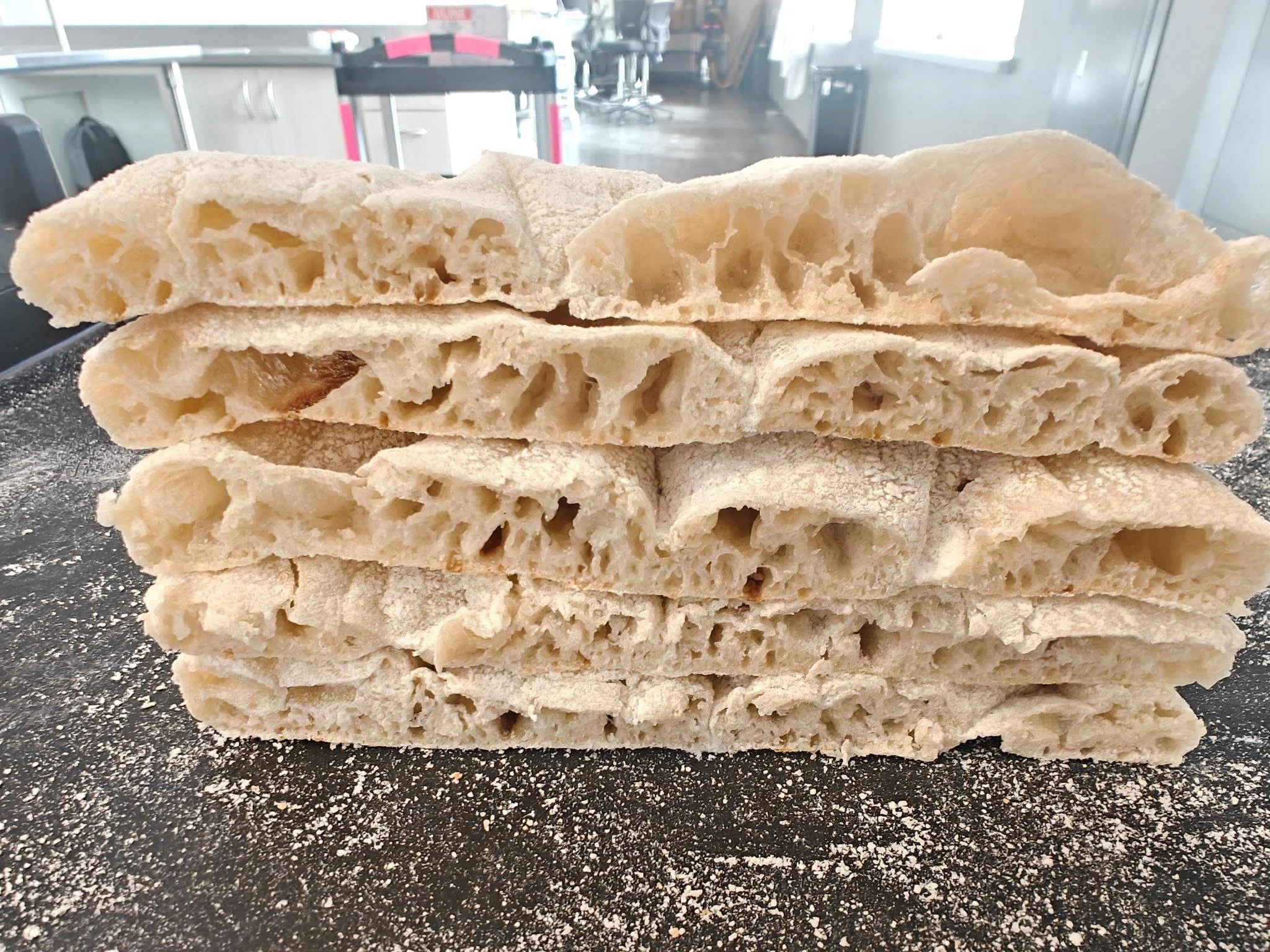
Pinsa long-fermentation dough.
The next chapter of Palermo’s growth started not in Milwaukee, but in Italy.
In 2022, the Palermo teams traveled repeatedly to Italy where they learned about pinsa, a long-fermentation, high-hydration dough that’s lighter, airier and easier to digest.
“What we saw in Italy wasn’t here in the U.S.,” Cokinos said. “Pinsa uses a 24-hour fermentation and very high hydration. The gluten structure breaks down, so you get a lower gluten content. The sugars also break down over time, so you get low glycemic characteristics. And the eating experience is incredible.”
The challenge: this dough behaves more like a batter than a typical pizza dough. Most industrial pizza lines simply cannot handle that level of hydration.
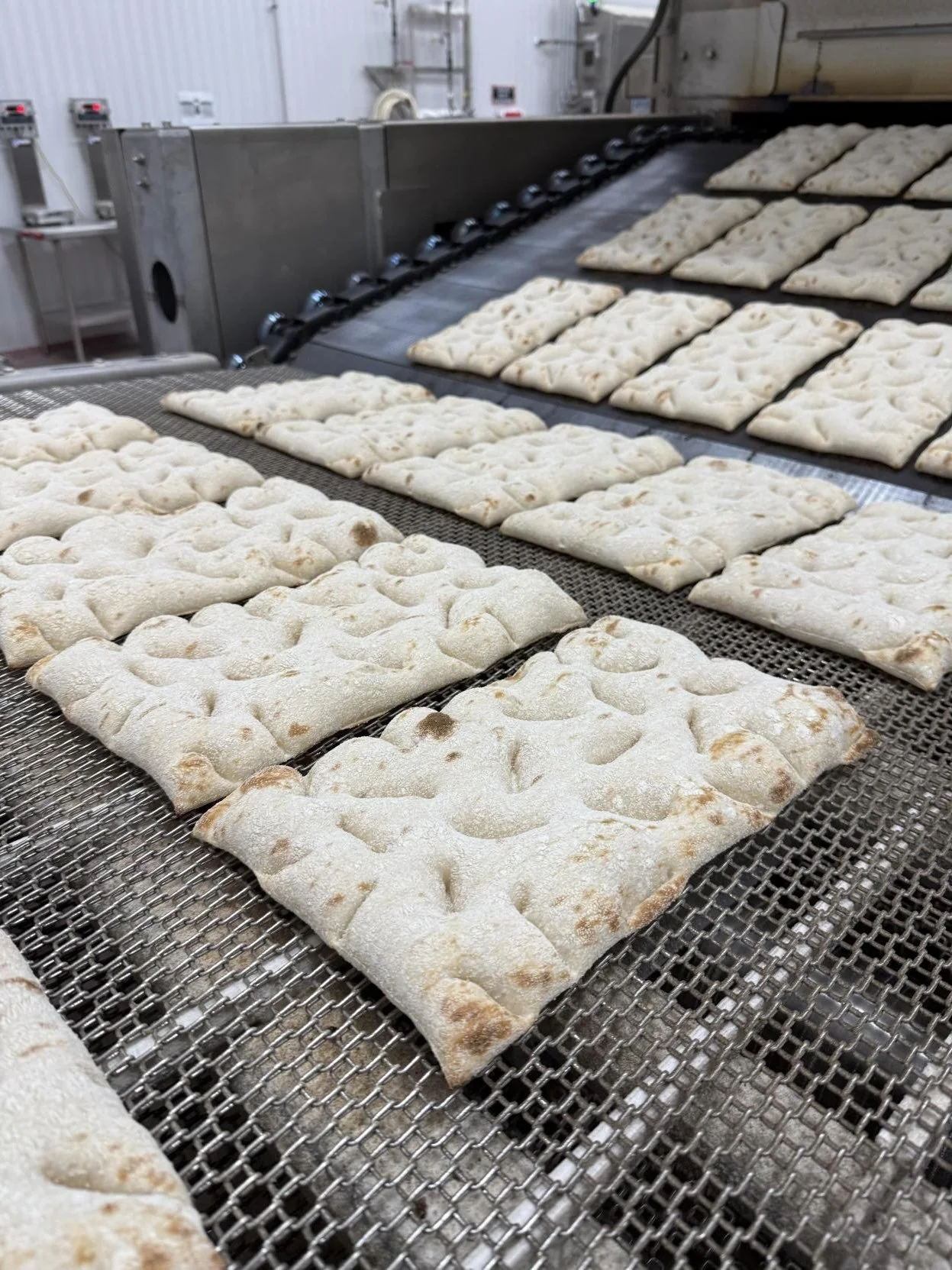
Pinsa dough produced by Palermo’s Pizza.
Cokinos recalled, “We realized we could assemble a line by combining pieces of equipment from different manufacturers. It took us almost three years to specify, order and integrate everything—and to build a new building around it.”
In August 2025, Palermo’s opened a new 200,000-square-foot facility in West Milwaukee dedicated to these products. Under the Urban Pie brand, Palermo’s has already launched pinsa-style / Roman-style pizzas using this dough, now available at Sprouts and Whole Foods Market, where early feedback has been very strong.
“We’re the only ones in North America that can do this combination of high fermentation, long proof, and low glycemic at scale,” Cokinos said. “And now we can bake it in a wood-fired oven, just like in Europe.”
Cracking Foodservice: The “Fab 7” and a Runway to 2030
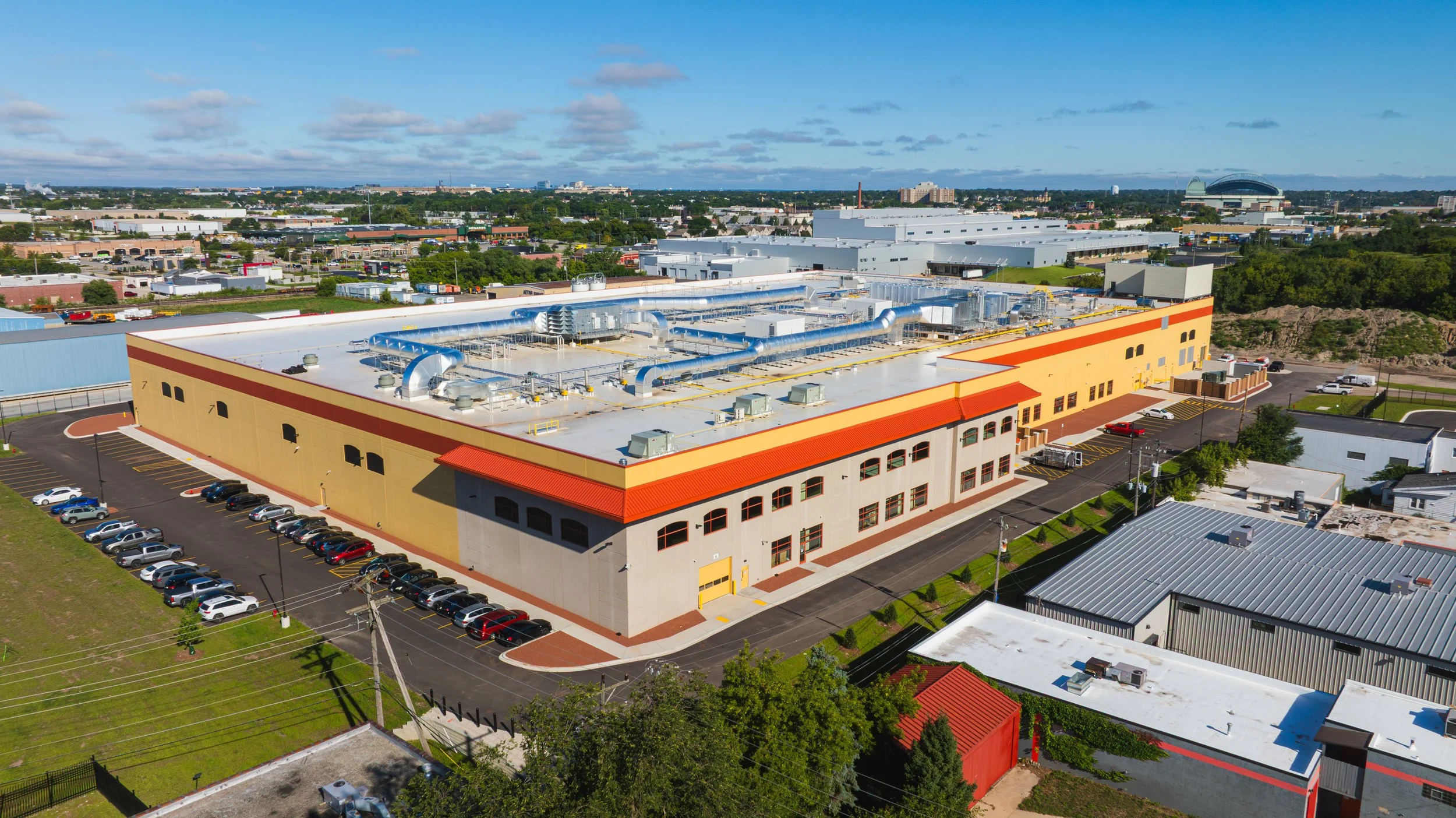
Palermo’s colorful and stylish West Milwaukee plant.
The West Milwaukee plant isn’t just about retail. It’s the foundation for Palermo’s biggest strategic push yet: foodservice. “We think foodservice will be half our business within the next five years,” Cokinos said without hesitation.
The company has developed what it calls the “Fab 7” — a lineup of seven SKUs designed specifically for foodservice operators:
5 pizza-style crusts
Rectangular, oval, and round formats
Pinsa-based formulas using rice flour, soy flour, and wheat flour
Various sizes to fit different menus and oven setups
2 Italian-style breads/rolls
Using the same long-fermentation, high-hydration formulas
Carrying the same low-gluten, lower-glycemic attributes
These products will be rolled out via broadline distributors including PFG, US Foods and Sysco, giving operators nationwide access to artisan-quality dough without the complexity.
The bet addresses a reality every successful concept faces: “Operators open one restaurant and make incredible pizza,” Cokinos explained. “Then they open a second, third, fourth location. The intricacies of managing that dough and fermentation are very difficult. They struggle to keep quality consistent.”
Palermo’s pitch: let the restaurant focus on brand, hospitality and toppings, while Palermo’s industrial expertise ensures uniform, high-quality bases across 1,000, 5,000 or even 10,000 locations.
It’s also a market-size play. Frozen retail pizza is a $6–7 billion U.S. category. Restaurant pizza is estimated at $50–60 billion.
“Consumers want convenience, and there’s no labor in the back of those stores anymore,” he said. “Pre-made crusts save a ton of labor and time and give consistency. That’s why we believe by 2030, foodservice will be at least half of our business.”
Palermo’s growth isn’t limited to pizza. The company has moved into adjacent frozen categories that leverage its manufacturing and logistics strengths:
Strombolis and calzones under the Screamin’ Sicilian brand
New frozen items that can use similar doughs, fillings and lines
Strategic investments in emerging brands that fit its frozen, CPG-friendly model
With three plants and open space in West Milwaukee, the company has room to bolt on additional capabilities as it identifies the right opportunities.
A Family-Owned Culture That Scales
Despite its scale, Palermo’s remains 100% family owned.
The second generation — including CEO Giacomo Fallucca and President Angelo Fallucca.
The third generation, including Giacomo’s sons Nick and Jasper, now active in the company.
The first generation is still present: family matriarch Zina still visits the factories and family regularly.
But it’s not a mom-and-pop shop.
“We’re a family business, but we’re also a professional organization,” Cokinos emphasized. “The executive team is composed of a combination of family members and non-family members. The reason we’re successful is the people in the business, talented folks who’ve been here a long time or joined to help us grow.”
Palermo’s is consistently voted “Best Place to Work” both nationally and in Milwaukee, a point of pride that Cokinos brings up quickly.
“We really value our teams,” he said.
Giving Back: Mentorship, Boards and the Natural Channel
Cokinos says the next chapter of his career is about giving back.
“I love helping young entrepreneurs start their businesses,” he said. “The industry has been very good to me and my family. Serving on boards and mentoring is a way to give back.”
He has served multiple terms on the board of IFMA (International Foodservice Manufacturers Association), is engaged in foodservice leadership circles, and currently sits on the board of The Pink Bakery, a pre-revenue, allergen-free baking mix company now gaining traction in the college and university foodservice channel.
And he’s looking to lean further into the natural and emerging brand ecosystem. For instance, he recently joined the Naturally Chicago board and is serving on its curated mentorship programs for early-stage founders.
As the frozen and foodservice pizza landscape evolves toward better ingredients, better texture and more convenience, don’t be surprised if a large share of what ends up on the plate — whether it’s branded, private label, or a restaurant crust — traces back to Palermo’s.
And if you bite into a light, airy, crisp-edged slice that almost feels too good to have come from a freezer box, there’s a decent chance you’re tasting Cokinos’ latest attempt to “leave” the pizza business — by reinventing it instead.
Jim Slama is the CEO of Naturally Chicago, a hub for the Midwest’s Natural Products community, and a founding board member of Naturally Network, the national association driving collaboration and growth across major U.S. markets. A passionate advocate for sustainable food and entrepreneurship, Jim actively serves on boards, advises and invests in brands shaping the future of the natural products industry.