
Wellness is Evolving, and AI is Reshaping Discovery — Highlights from Naturally Chicago’s Feb. 24 Webinar
Wellness Is Evolving, and AI Is Reshaping Discovery
Key Insights from Naturally Chicago’s February 24 Webinar on the Future of Wellness, Consumer Trust and AI-Driven Commerce
The wellness industry is undergoing a fundamental transformation. Consumers are no longer passive buyers, browsing store shelves or searching for generic health advice online. Instead, they are informed, data-driven participants seeking personalized solutions tailored to their bodies, lifestyles and values.
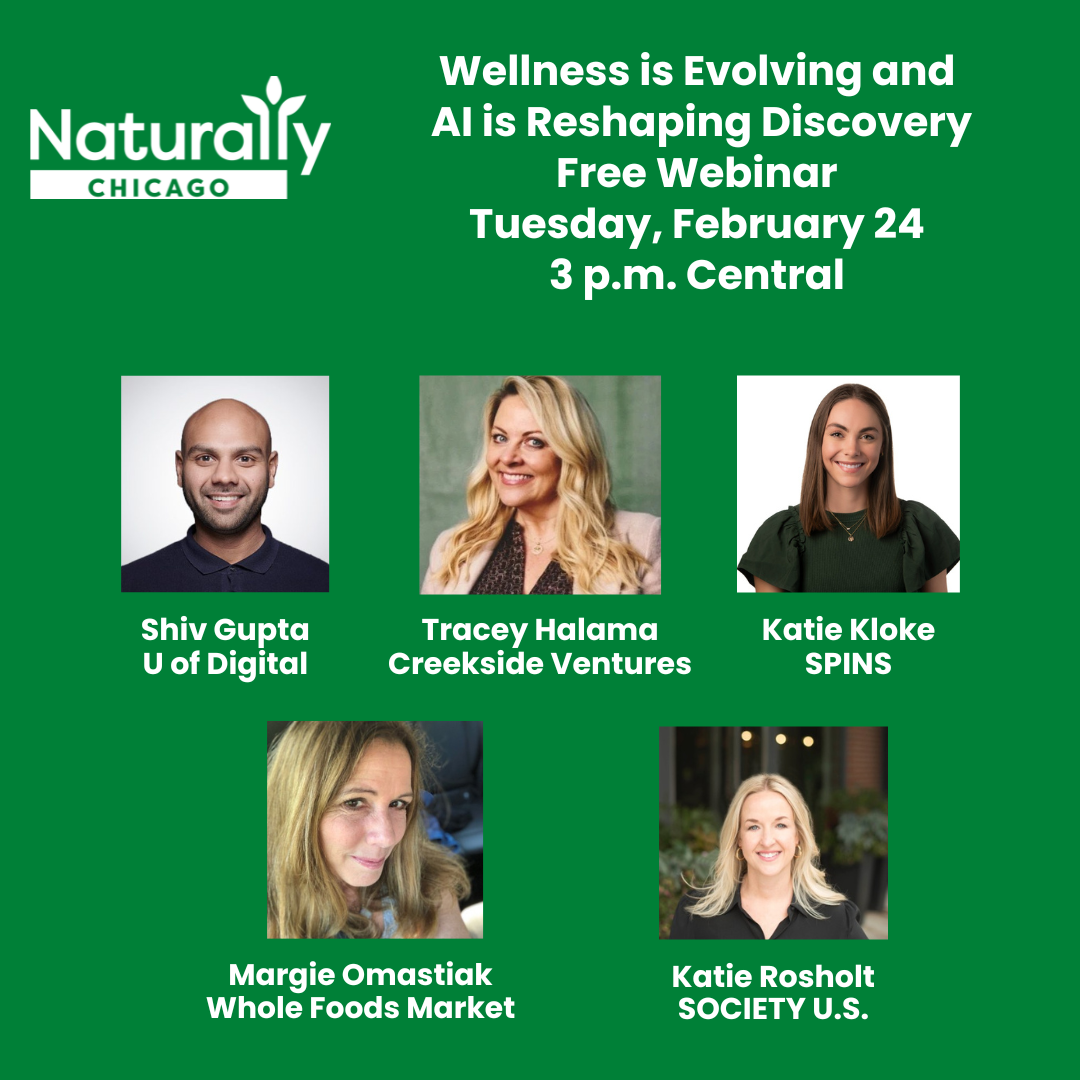
At Naturally Chicago’s February 24 webinar — Wellness Is Evolving and AI Is Reshaping Discovery — industry leaders from retail, data analytics, brand building and technology explored how wellness consumers are changing... and how artificial intelligence is redefining how products are discovered, evaluated and purchased.
Across the discussion, one theme emerged clearly: AI is emerging as the interface between brands and consumers, reshaping trust, discovery and competitive advantage in wellness.
The following are insights from these panelists:
Shiv Gupta, Founder, U of Digital
Tracey Halama, Founder & CEO, Creekside Ventures
Katie Kloke, Senior Manager, SPINS
Margie Omastiak, Senior Forager for Local and Emerging Brands, Whole Foods Market
Katie Rosholt, Managing Director of Society U.S., moderated the discussion.
We believe you will find the following insights informative and valuable. For a deeper dive, click the button below to view the full webinar video recording.
Wellness Shopping is Now an Enduring Consumer Trend
According to panelists, wellness is no longer a niche category. It has become mainstream consumer behavior.
Katie Kloke of SPINS noted that nearly all consumers now purchase some form of wellness product, from supplements and functional beverages to organic foods and better-for-you snacks.
Key Characteristics of Today’s Wellness Consumer
1. Wellness is universal
Roughly 99% of shoppers purchase wellness products in some form.
Products positioned as natural drove nearly half of recent in-store growth.
Wellness now spans every category, not just supplements.
2. Conscious consumption drives decisions
Consumers increasingly balance:
Health goals
Budget constraints
Personal values
Taste and enjoyment
Purchases are intentional rather than aspirational.
3. Label literacy is rising
Younger consumers especially:
Scrutinize ingredient lists
Research unfamiliar ingredients instantly
Use AI tools or search platforms for validation
4. Functionality matters
Major drivers include:
Protein and fiber optimization (“maxing” trends)
Clean labels
Functional benefits embedded into everyday foods
Active lifestyle support
5. Omnichannel shopping is the norm
73% of consumers shop across multiple channels.
Discovery happens both online and in natural retail environments.
Takeaway Quote:
“More than ever, everyone is a wellness consumer.”
From Education to Transparency: How Wellness Expectations Have Matured
Tracey Halama — founder and CEO of Creekside Ventures and former CEO of Vital Proteins — offered a decade-long perspective on how wellness branding has evolved.
Ten years ago, brands needed to educate consumers about entirely new ingredients. Today, consumers arrive informed... and skeptical.
Then vs. Now in Wellness Marketing
Then: Ingredient education
Now: Ingredient verification
Then: Claims-led marketing
Now: Transparency-led trust
Then: Category novelty
Now: Functional proof
Then: Brand storytelling
Now: Authentic problem-solving
Consumers now expect brands to clearly communicate:
Ingredient sourcing
Functional outcomes
Product purpose
Authentic brand mission
Flavor remains the entry point — but credibility drives loyalty.
Takeaway Quote:
“If you don’t have a good-tasting product, you’ll never win the consumer back. But ingredients and functionality come next.”
The Rise of Credible Recommenders
Trust increasingly comes from:
Functional practitioners
Registered dietitians
Medical experts
Influencers aligned with specific life stages
Importantly, credibility is audience dependent. Different demographics trust different voices.
Wellness Expands Beyond Nutrition
From a retail perspective, Margie Omastiak of Whole Foods Market emphasized that wellness now extends far beyond what consumers eat.
Today’s wellness evaluation includes:
Packaging sustainability
Brand mission and ethics
Environmental impact
Product origin stories
Emotional and experiential appeal
Consumers seek balance — nourishment alongside enjoyment.
Takeaway Quote:
“Wellness isn’t just nutrition anymore. It’s how the product shows up in the world.”
Retailers remain critical trust filters for consumers. While digital platforms offer infinite shelf space, physical retail still signals credibility through curation.
Discovery Is Shifting: AI Becomes the New Storefront
Perhaps the most transformative discussion centered on discovery.
Shiv Gupta of U of Digital explained that AI is fundamentally reshaping how consumers move from curiosity to purchase.
AI Is Collapsing the Marketing Funnel
Historically:
Awareness
Research
Comparison
Purchase
Now, all steps can happen within a single AI interaction.
A consumer might ask an AI assistant:
What supplement helps gut health?
Which brands are best?
Where can I buy it?
They can then complete a purchase minutes later.
New AI Discovery Interfaces
Retail AI assistants
Amazon’s Rufus
Walmart’s Sparky
Conversational shopping tools embedded into retail platforms
These assistants:
Answer product questions
Recommend items
Improve conversion rates
Increase loyalty and engagement
Large Language Models (LLMs)
Consumers increasingly consult:
Chat-based AI tools
Personal AI assistants
Conversational search engines
These systems pull information from across the internet, meaning brands must ensure their data is accessible and accurate.
Takeaway Quote:
“AI is collapsing the funnel — discovery to purchase can happen in one session.”
Generative Engine Optimization: The New SEO
As AI replaces traditional search behaviors, brands must rethink their discoverability.
Gupta described the rise of Generative Engine Optimization (GEO) — optimizing content for AI recommendations rather than search rankings.
Content That AI Systems Prefer
AI models favor:
FAQ-rich content
Comparison tables
Clear product explanations
Multi-source credibility
Structured data
Unlike traditional SEO, results are probabilistic. That means brands must continuously test how they appear across platforms.
Validation Requires Continuous Testing
Because AI responses vary:
Identical prompts produce different answers.
Brands must test across models and prompts.
Optimization becomes iterative rather than fixed.
New tools now simulate consumer personas (“synthetic audiences”) to test messaging at scale.
Personalization at Scale: Wellness Gets Individual
Personalization emerged as one of the most powerful forces that are shaping wellness.
Consumers increasingly use:
Wearables
Health biomarker testing
AI health analysis
Online communities
These inputs create deeply individualized wellness journeys.
Drivers of Personalized Wellness
Sleep and recovery tracking
Longevity optimization
Life-stage health needs
Community-driven advice
Self-directed research
Consumers increasingly treat platforms, like TikTok or AI chat tools, as informal health advisors before consulting professionals.
Takeaway Quote:
“Wellness has never been this personal before.”
Yet personalization does not mean infinite SKUs. Katie Kloke emphasized that success comes from understanding consumers deeply — not creating endless product variations.
Brands must identify:
Who their customer is
Where they shop
What claims resonate
Which problems they are solving
Balancing Personalization and Scale
Retailers and brands face a paradox:
Scale requires broad accessibility.
Personalization requires emotional relevance.
The solution lies in shared empathy.
Consumers want products that feel personally relevant while still belonging to broader cultural conversations, such as menopause support, gut health or women’s performance nutrition.
Emerging examples include:
Creatine expanding beyond bodybuilding audiences
Functional products targeting specific life stages
Community-driven wellness adoption
Takeaway Quote:
“Personalization looks for empathy and commonality at the same time.”
AI’s Growing Role in Creative and Marketing Execution
AI is rapidly embedding itself across marketing workflows.
Creative Transformation
AI now assists with:
Ideation
Copywriting
Video production
Content scaling
Feedback loops
This democratizes marketing production but increases the need for human oversight to protect brand integrity.
AI-Powered Media Optimization
Major platforms now automate campaign execution:
Google Performance Max
Meta Advantage+
Amazon Performance tools
Marketers increasingly set goals while AI handles optimization.
The Rise of AI Agents
Next-generation AI systems will:
Execute workflows automatically
Manage marketing tools
Reduce manual software interaction
Takeaway Quote:
“Agents will change how marketers work — software will work for us instead of the other way around.”
What Brands Should Do Now
Across discussions, several actionable strategies emerged.
Winning Playbook for Wellness Brands
1. Lead with authenticity
Clearly articulate the problem you solve.
Build trust through transparency.
2. Optimize for AI discovery
Structure content clearly.
Publish FAQs and comparisons.
Ensure accurate digital product data.
3. Invest in credible voices
Experts and practitioners matter.
Community validation drives adoption.
4. Understand your consumer deeply
Personalization starts with insight, not product proliferation.
5. Embrace experimentation
AI outcomes are probabilistic.
Continuous testing is essential.
6. Maintain human empathy
Technology scales reach — but trust remains emotional.
The Future: AI as the Wellness Interface
The webinar concluded with a shared understanding: AI is not replacing wellness brands or retailers. Instead, it is becoming the connective tissue linking consumers to solutions.
Consumers increasingly ask AI:
What should I take?
What works for someone like me?
Which brand can I trust?
Brands that succeed will be those that remain:
Findable
Credible
Chosen
In a world where algorithms increasingly guide discovery, the competitive edge will belong to companies that combine technological fluency with authentic human understanding.
Final Takeaway:
“Wellness shoppers want personalized answers — and AI is becoming the interface that delivers them.”