
Hiring for Growth: Building Your Team — Highlights from Naturally Chicago’s Webinar
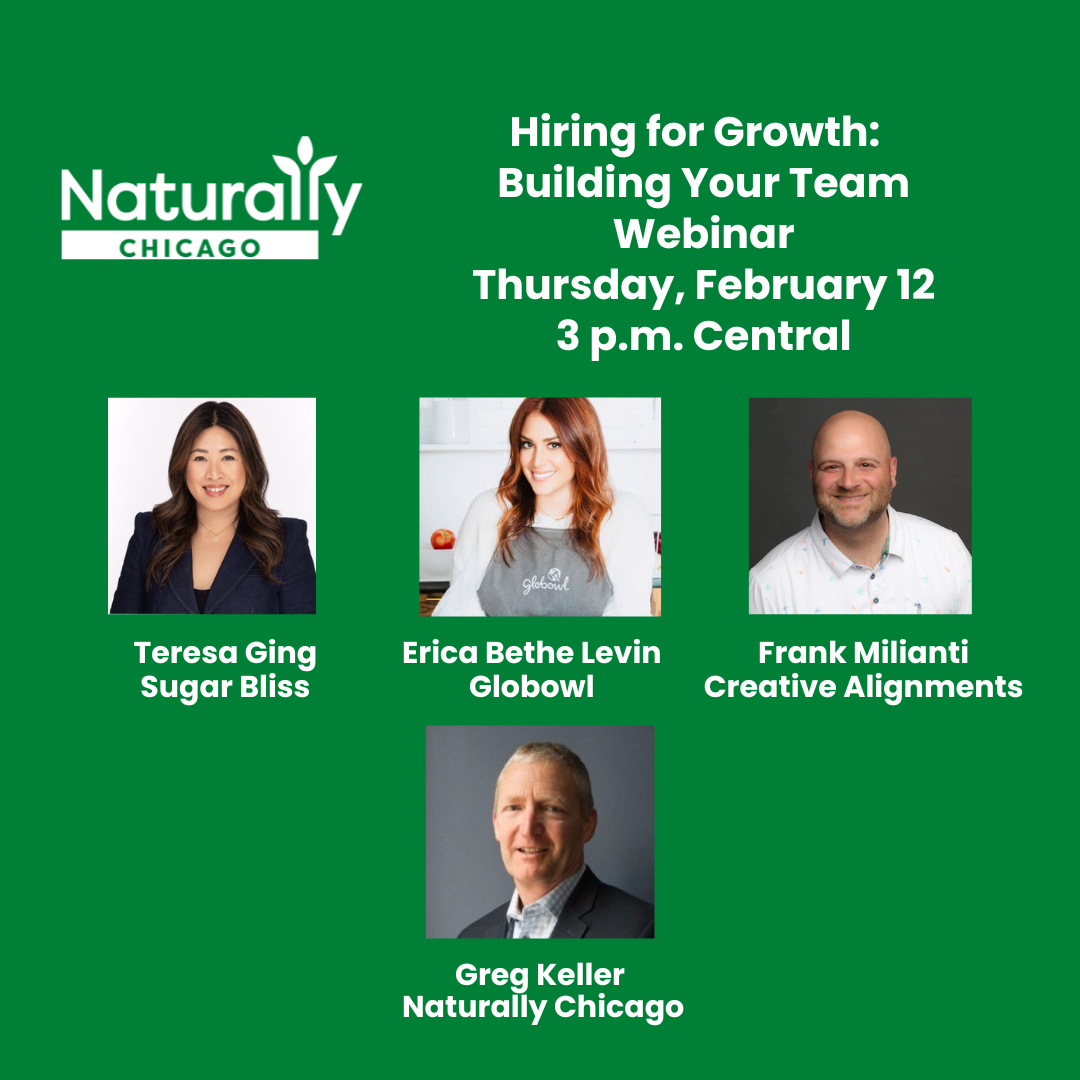
Hiring for Growth: Building Your Team — Highlights from Naturally Chicago’s February 12 Webinar
Startup natural products businesses confront many difficult decisions in terms of product ingredients and recipes, production, logistics, sales and marketing and more.
Hiring a team of employees and/or contractors to carry out the company’s mission and goals is one of the most consequential, challenging and impactful decisions founders make.
Naturally Chicago presented a candid discussion on this important issue in its February 12 webinar, Hiring for Growth: Building Your Team. Greg Keller — Naturally Chicago’s senior strategist and lead brands advisor — moderated the conversation with three expert panelists:
Erica Levin, Founder of Globowl, which produces chef-created, internationally flavored food for babies and toddlers
Teresa Ging, Founder & CEO of Sugar Bliss Cakes, maker of delicious pastry treats
Frank Milianti, Partner at Creative Alignments, which provides recruiting services for companies in the natural products industry and other sectors.
The conversation explored when to hire, how to structure early teams, fractional vs. full-time decisions, culture fit, recruiters, brokers, and practical interviewing strategies.
Below is a summary organized by theme, with key insights and takeaway quotes. We hope you find them informative and useful.
And for a deeper dive, click the button below to view the full webinar video recording.
1. Start with the Right Foundation: Build Your “BAIL” Team
Before hiring internally, founders must establish a strong external advisory base.
Teresa Ging introduced the “BAIL” framework:
Banker
Accountant
Insurance
Lawyer
These professionals protect and stabilize your business as you scale.
Key Points
Multiple banking relationships support capital access and lines of credit.
Accountants ensure clean financials, tax strategy and margin clarity.
Insurance (including recall insurance for CPG producers) mitigates catastrophic risk.
Legal support is essential for contracts, trademarks and compliance.
“As business owners, you never want to go to jail—but if you go to jail, you must have BAIL.”
Takeaway: Founders often obsess over growth, while neglecting foundational protections. External advisors are not optional — they are strategic infrastructure.
2. When Should You Hire?
A common mistake: hiring too late.
Signals It’s Time to Hire
The founder becomes the bottleneck.
Revenue grows, but execution or margin stalls.
Logistics and operational complexity consume strategic time.
You’re working unsustainably (90-hour weeks, constant firefighting).
Erica Levin’s trigger point: operational complexity in CPG —manufacturing, third-party logistics (3PL), and more —crowded out work to grow the company.
“When logistically it became too complicated… and I couldn’t focus on revenue-generating activity — that’s when I needed help.”
Frank Milianti’s perspective:
When everything flows through the founder — decisions, emails, operations — you are the constraint.
Takeaway: Hire before crisis mode can hit. Hiring is about buying back the founder’s time to focus on growth.
3. First Hires: Fill Your Blind Spots
A consistent theme: don’t clone your strengths.
Strategic Approach
If you’re brand-driven → hire operational strength.
If you’re sales-driven → hire finance or supply chain.
If you’re visionary → hire execution.
Teresa’s first CPG hire: a fractional Chief Operating Officer (COO) with multi-disciplinary experience across bakery ops, retail, and co-manufacturing.
“I found the person that filled the gap — not the strength.”
Frank’s framing:
Your first hires stabilize and unlock growth — they are not your future $50M executive team.
Takeaway: Early hires need versatility. Specialization increases as scale increases.
4. Fractional, Contractor, Broker or Full-Time?
This was a central strategic discussion.
Fractional Roles
Best when:
Cash flow is volatile.
Expertise is needed but not full-time.
Testing leadership capability.
Examples:
Erica: Fractional Chief Financial Officer
Teresa: Fractional COO
Fractional Chief Marketing Officer
“At this stage, cash flow is a roller coaster. I won’t hire full-time until it’s stable.” – Erica
Contractors
Useful for:
Graphic design
Shopify
Amazon management
Marketing execution
Brokers
Best when:
You need retailer relationships and market access.
Caution:
Brokers may lack founder-level passion.
Fit depends on channel alignment.
Teresa learned that conventional retail was less aligned for her premium cookie brand and pivoted toward foodservice.
Full-Time Hires
Appropriate when:
Work is ongoing and core to the business.
Institutional knowledge matters.
Cash flow is stable.
Teresa’s summary framework:
Contractor/fractional → specific expertise, limited budget
Broker → retail access
Full-time → ongoing core function
Takeaway: Hiring is layered. Build capability and capacity incrementally.
5. Cash Flow Discipline in CPG
Both founders emphasized the cash intensity of CPG:
Co-manufacturers
Distributors
Brokers
Retail margins
Demo costs
“We pay the co-man, distributor, broker, retailer… and then we’re left with the penny.”
Stable cash flow should precede high salary commitments.
Takeaway: Optimism must be balanced with financial realism.
6. Culture and Fit: Hiring Beyond the Resume
Technical skills are necessary—but insufficient.
Cultural Evaluation Tactics
Multiple interview rounds.
Team interviews (even frontline staff).
Informal settings (coffee meetings).
Advisor involvement in final interviews.
Erica’s approach:
Observe candidates in casual environments to assess authenticity.
Teresa’s lesson:
Poor culture fit costs months of training and momentum.
“If they don’t understand your culture, they won’t represent your brand.”
Frank added an important reminder:
“You also have to put your best foot forward. Culture is reciprocal.”
Takeaway: Culture is not soft—it’s strategic. Misalignment is expensive.
7. The Role of Recruiters
Why use recruiters?
Time savings.
Industry network depth.
Cultural and behavioral screening.
Role definition and compensation benchmarking.
Frank emphasized the importance of defining outcomes before reviewing resumes.
“Slow down to hire intentionally.”
Greg Keller reinforced that recruiters:
Reduce resume overload (hundreds per posting).
Pre-qualify candidates.
Accelerate hiring cycles.
Takeaway: Recruiters are strategic partners, not just resume filters.
8. Networking as a Talent Engine
The CPG ecosystem is relationship driven.
Sources of talent:
Industry events
Naturally Chicago
Accelerator programs
LinkedIn outreach
Legal and accounting referrals
Peer founder networks
“The power of community in CPG is strong.”
Takeaway: Community building is a hiring strategy.
9. Free Help, Family Help & Equity
Free labor can help —but requires boundaries.
Risks
Misaligned expectations.
Lack of priority.
Delayed accountability.
Equity dilution too early.
“You get what you pay for.”
Teresa shared how hiring a professional accountant improved both speed and tax optimization— even over family support.
Best Practices
Use Non-Disclosure Agreements.
Set defined trial periods.
Avoid giving equity prematurely.
Clarify scope up front.
Takeaway: Free support is acceptable early — but transition to professional rigor quickly.
10. Hire Slow, Fire Fast
Perhaps the most sobering theme.
Keeping an employee who is a poor fit can damages:
Culture
Morale
Execution
Founder energy
“The biggest regrets are when we didn’t remove someone who was poisoning the team fast enough.” — Greg Keller
Takeaway: Protect the team. Decisive action preserves culture and performance.
11. Final Guidance from the Panel
Frank Milianti
Build in layers.
Hire intentionally.
Don’t overbuild too soon.
Teresa Ging
Align hiring type to business need.
Protect cash flow.
Define role scope clearly.
Erica Levin
Stay laser focused on revenue.
Ensure financial stability before major hires.
Passion and adaptability matter early.
Core Themes
Hiring is strategic timing — not reactionary.
Early hires must be generalists willing and able to adapt.
Fractional roles are powerful for emerging brands.
Culture fit determines long-term success.
Cash flow discipline governs hiring decisions.
Community accelerates talent discovery.
Move quickly when someone isn’t right.
Closing Thought
Building a team is not about assembling headcount — it’s about layering capability intentionally. As emerging brands scale, the founder’s job shifts from “doing everything” to architecting the right mix of expertise, culture and financial discipline.
Hiring well doesn’t just support growth. It determines whether growth is sustainable.