
Early-Stage Brand Fundraising: How to Get the Legal Basics Right (Recap of Naturally Chicago Webinar)
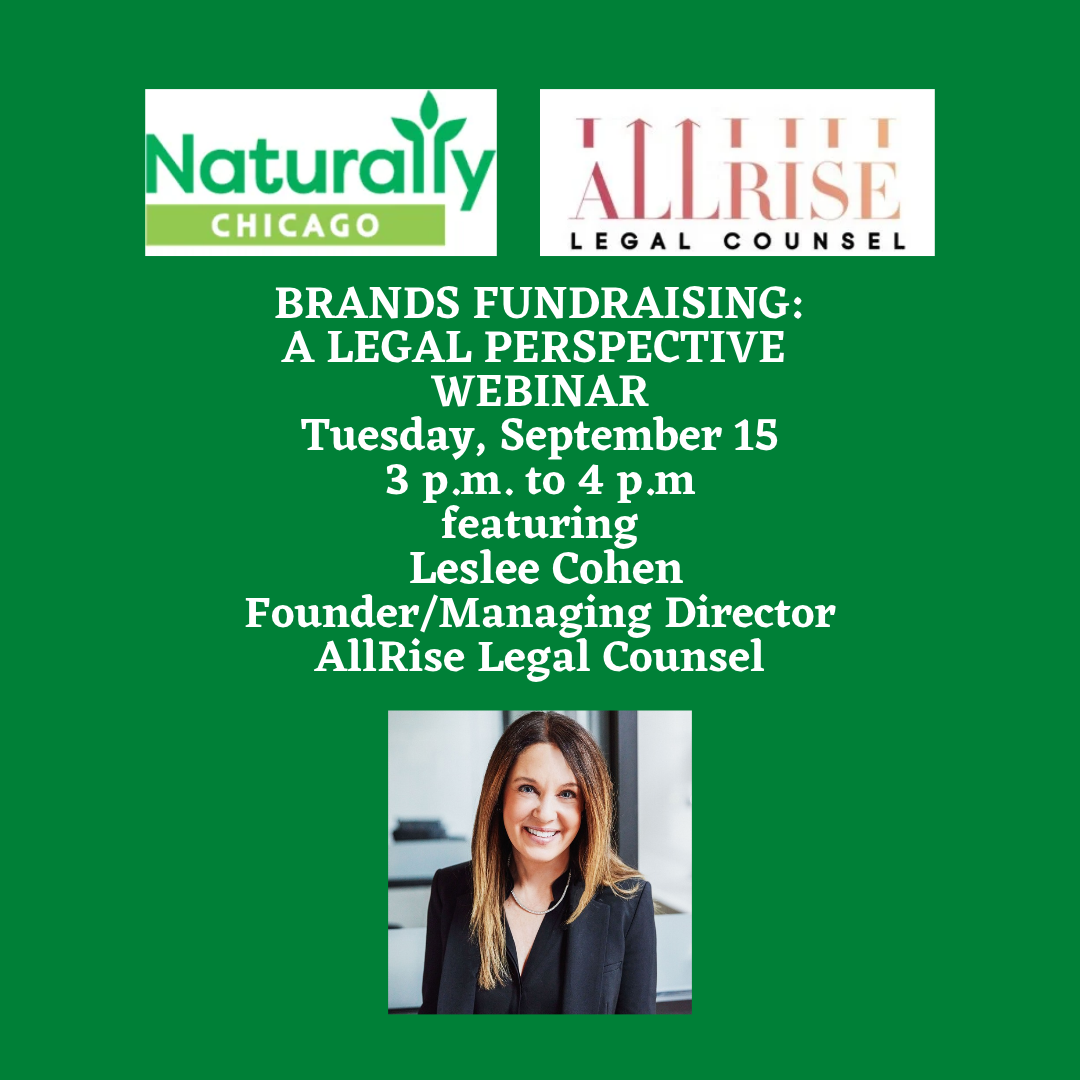
For natural products entrepreneurs, raising money is typically essential in turning a promising concept into a sustainable company.
But doing it incorrectly can create legal and financial problems, which can haunt a business long after the initial investment has been spent.
That was the central message of Leslee Cohen — founder and managing partner of Chicago-based AllRise Legal Counsel — during a Naturally Chicago webinar on early-stage fundraising.
Leslee brought more than three decades of legal experience to the discussion, including two decades working at large law firms in Wall Street securities practices before she founded AllRise in 2010. She focuses on providing entrepreneurs with sophisticated legal advice through a flexible and relationship-driven model.
Her goal for the webinar was not to turn entrepreneurs into securities lawyers. It was to make sure they understand enough about the process to recognize what they actually need — and avoid paying for what they don't.
"If you're going to raise money and you were to hire counsel, you walk into a meeting with your counsel on an educated basis," Cohen said.
That distinction matters, she said, because entrepreneurs can encounter lawyers at opposite ends of the spectrum:
* One who might tell a startup raising less than $1 million that it needs an elaborate private placement memo, which would cost $10,000 in legal fee.
* Another who might suggest simply downloading a standard SAFE (Simple Agreement for Future Equity) document, filling in a valuation cap and discount, and calling it a day.
Leslee described the first approach as "craziness," but added that the second isn't the answer either.
The challenge, she said, is finding the middle ground: enough legal work to protect the company and comply with securities laws — without allowing legal costs to consume money that a young business needs to grow.
Naturally Chicago urges you to read the following recap — and to view the video of the full webinar, please click the button below.
Friends, Family and Strategic Investors
One of the first decisions entrepreneurs face is where to seek their initial capital. In many cases, friends and family may be the most accessible sources, particularly when an entrepreneur is starting a business with little or no operating history.
Leslee’sadvice is straightforward: If that's where the money is, use it.
But friends and family investors don't necessarily have the same understanding of startup investment instruments as professional or "serial" investors.
Leslee said that can become an issue if a founder proposes a SAFE. Although the SAFE has become a standard early-stage investment instrument, someone who is unfamiliar with startup finance may look at the document and wonder what exactly they are buying.
"Friends and family say, 'What is this thing? I don't understand it,'" she said.
Experienced angel investors, by contrast, are generally familiar with SAFEs and convertible notes. They may also provide something that friends and family typically cannot: strategic advice, industry contacts and other connections that can help a company grow.
The tradeoff is that professional investors are much more likely to negotiate.
Friends and family may look at a proposed term sheet and simply say yes. Experienced investors understand the market and may seek more favorable terms for themselves.
There is another important distinction. Some friends and family investors may be "non-accredited" under federal securities laws. Because regulators provide additional protections to non-accredited investors, raising money from them can involve additional requirements.
Convertible Notes and Why They Became Popular
Leslle explained that the fundamental challenge in early-stage fundraising is valuation. If a new company needs $100,000 or $200,000, how much of the company should the founder give the investor in exchange for that money?
"There is no answer," she said. A startup may have ambitious plans and financial projections, but there may not yet be enough information to establish a defensible valuation.
Convertible notes emerged as one way of postponing that valuation decision.
An investor provides money to the company and receives a promissory note. Like a conventional loan, the note has an interest rate and maturity date. But instead of necessarily being repaid in cash, the note can convert into equity when the company subsequently raises a qualifying round of capital.
For example, if a company eventually sells preferred stock at $10 a share, an investor who supplied early capital through a convertible note might receive a 20 percent discount, effectively converting at $8 a share.
The discount rewards the investor for taking the risk of investing before the company's value was established.
Convertible notes can also contain a valuation cap. If a company becomes extraordinarily valuable before the note converts, the cap ensures that the early investor still receives the benefit of having taken that early risk.
"If the company is really worth $50 million in three years — a dream come true — instead we're going to cap that valuation at, say, $5 million," Leslee explained.
The Rise of SAFEs
The problem with a convertible notes is that it has a maturity date. A three-year maturity, which was common in startup notes, can be a very short time in the life of a young company. If the startup hasn't raised another financing round by the time the note comes due, the company may not have the money to repay it.
That can force founders and investors back to the negotiating table, creating additional legal expenses and tension.
Around the middle of the past decade, the SAFE emerged as an alternative. Developed by Y Combinator, the Simple Agreement for Future Equity eliminates the maturity date and interest component of a convertible note.
An investor provides money and receives a contractual right to receive equity if a qualifying financing or sale occurs. Like convertible notes, SAFEs typically include a valuation cap and/or discount.
Leslee said she is particularly fond of SAFEs because they have become highly standardized.
"The reason that I really like it," she said, "is, believe it or not, no matter what reputation lawyers get, we at least at AllRise understand that startups do not have a lot of money that they want to be spending at all, let alone on legal fees."
Standard SAFE forms are available through Y Combinator, and because the documents generally are not heavily negotiated, they can significantly reduce legal costs.
There are exceptions. A major investor may request a "side letter" providing additional rights, such as regular financial information, a pro rata right to participate in future fundraising, or "most favored nation" treatment.
The latter means that if the company later offers investors better terms in another SAFE offering, the investor receives the benefit of those better terms as well.
Leslee also noted that state-specific requirements can complicate matters. Illinois, for example, has an angel investor tax credit with requirements affecting the timing of SAFE conversions.
The apparent simplicity of SAFEs can create another danger for founders: losing track of how much of their company they are giving away.
"It is so great! People are willing to give me money," Leslee said, describing the mindset that can take hold when entrepreneurs are raising their first capital. But every SAFE or convertible note eventually affects ownership.
Leslee urged founders to model the consequences before accepting the money. She recommended Carta's SAFE conversion calculator as a useful tool for testing different fundraising scenarios and seeing how valuation caps, investment amounts and subsequent rounds affect founder ownership.
"I can't tell you how often you'll hear about, 'Oh, so-and-so sold their company for millions and millions of dollars.' They're not actually walking away with very much because they raised so much money through time using these different instruments," she said.
For entrepreneurs, the lesson is simple: Raising money is not the same thing as creating value for the founders. The terms of the money matter.
Series Seed: Potential Middle Ground
Leslee also said that once a company is ready for a priced equity round, the founder(s) should consider an option that can fall between the early SAFE or convertible-note stage and a traditional Series A.
That option is a Series Seed round.
Series A can involve extensive documentation and negotiation. Leslee noted that the standard National Venture Capital Association documents can include multiple agreements running roughly 30 pages each. That process generates substantial legal expenses for both the company and, in many cases, the founders who are expected to cover investors' legal bills.
A Series Seed round can be considerably simpler. Typically involving a raise of roughly $1 million to $2 million, and potentially up to $3 million, it involves preferred stock but substantially less documentation.
"There are two documents," Leslee explained. "There is an amendment to your certificate of incorporation, and there is a purchase agreement, and that's it."
Another advantage from the founder's perspective is that Series Seed investors generally do not receive the anti-dilution protections that can become important in later rounds.
Leslee said she has seen Series Seed investors remain invested as companies progress into Series A and Series B rounds. Because they invested earlier and typically wrote smaller checks, they can participate without the extensive negotiation that accompanies larger institutional investments.
Understanding Securities Laws
Perhaps the most important part of Leslee's presentation was her explanation of why entrepreneurs cannot simply take a standard SAFE, collect checks, and assume everything is legally covered.
Two federal securities laws are particularly important.
The Securities Act of 1933 generally requires securities offerings to be registered with the federal Securities and Exchange Commission unless an exemption applies. For startups, the most common route is a private-offering exemption under Regulation D.
Leslee focused on two versions.
Under Rule 506(b), a company cannot engage in general solicitation. An entrepreneur can't simply post on social media that the company is raising money and invite anyone to invest. There generally must be a pre-existing relationship with the investors.
The offering can include up to 35 non-accredited investors, subject to additional requirements.
Rule 506(c), by contrast, permits general solicitation. A founder can advertise the fundraising publicly, including online. But every investor must be accredited, and the company has an obligation to verify that status.
An accredited investor is generally defined as someone with at least $1 million in net worth excluding a primary residence, or qualifying income of $200,000 individually or $300,000 jointly with a spouse.
A third alternative is equity crowdfunding under Regulation Crowdfunding. Platforms such as Wefunder and StartEngine facilitate offerings in which investors actually receive an ownership interest in the company. That differs from Kickstarter or Indiegogo campaigns, in which people may receive products, early access or merchandise, but do not receive an ownership stake.
Regulation Crowdfunding allows companies to raise up to $5 million in a 12-month period and permits participation by non-accredited investors.
State securities laws also matter. The requirements vary according to the state in which an investor resides, including whether a filing or fee is required.
Anti-Fraud Obligation
The other major federal statute Leslee highlighted is the Securities Exchange Act of 1934, particularly its anti-fraud provisions. The basic principle is that investors must receive the information that a reasonable person would want to know in deciding whether to invest.
That means entrepreneurs can't present only the upside. If a company faces substantial competition, regulatory uncertainty, operational risks or other significant challenges, those risks need to be disclosed.
Leslee recommended that entrepreneurs separate their fundraising pitch from their legal disclosures. "Your deck is your sales piece," she said. "This document, this is your insurance policy."
At AllRise, she said, the process generally involves a subscription agreement accompanied by two exhibits.
The first provides basic information about the company: its product(s), market, marketing plan, intended use of proceeds, capitalization and management. The second is a comprehensive description of the risks associated with the investment.
Leslee's clients review a broad list of potential risks, remove those that do not apply and add risks specific to their businesses and industries.
The objective is not to discourage investment. It is to establish a record showing that investors understood the risks before putting their money into the company. "I've been doing this for 35 years," Leslee said. "I have never once had a client be sued because I always insist that these documents are completed."
Beware Fundraising Middlemen
Leslee also offered a warning about a practice that can put both entrepreneurs and would-be fundraisers on dangerous legal ground.
Founders are sometimes approached by people who offer to introduce them to investors in exchange for a percentage of whatever money they raise.
If someone regularly makes securities introductions for compensation without being properly registered as a broker-dealer, that arrangement can violate securities laws. And Leslee said founders can potentially face liability for aiding and abetting an improper arrangement.
The fact that the person claims to have an extensive network of accredited investors or family offices does not change the underlying issue. Her advice: Be careful about anyone who wants to be paid a percentage of the securities raised.
How Angels and Venture Capitalists Differ
During the question-and-answer session, Leslee also drew a distinction between angel investors and venture capital firms.
Angels generally invest their own money, often at a very early stage. They may be willing to invest before a company has revenue, and many are attracted to particular industries or missions in addition to the possibility of financial returns.
Venture capital firms, by contrast, raise funds from their own investors and have a fiduciary and financial responsibility to deploy that capital with the expectation of generating returns. As a result, VCs tend to invest later, often in priced preferred-stock rounds, and their expectations of the company and its founders can be considerably different.
"They don't hate you," Leslee said of founders who sometimes feel battered by the VC fundraising process. "They're in business to make money. They have investors that they need to answer to."
That distinction becomes particularly important as a company moves from pre-seed fundraising into Seed and Series A financing.
There is no universally fixed definition of "pre-seed" and "seed," Leslee noted. But industry practice generally uses pre-seed to describe SAFE or convertible-note financing without an established valuation, while a Seed round increasingly refers to a priced preferred-stock financing.
The difference is substantial.
At the pre-seed stage, founders generally establish the terms and offer them to investors. At a priced Seed or later round, particularly when institutional investors are involved, the investor — and especially the lead investor — may provide the term sheet and negotiate aggressively.
In that case, the founder's bargaining position can change dramatically.
The Bigger Lesson
Leslee Cohen’s presentation ultimately went beyond the mechanics of SAFEs, convertible notes and securities exemptions. Her message was that entrepreneurs should view legal counsel as part of the fundraising strategy rather than an administrative expense to be minimized at all costs.
At the same time, she cautioned against paying large-law-firm prices for work that doesn't require large-law-firm complexity.
For natural products entrepreneurs, who often face the additional challenges of manufacturing, distribution, regulation, inventory and working capital, preserving as much of the capital raised as possible is critical.
The goal, she emphasized, is not simply to get investors to write checks. It is to raise the right amount of money, on terms the founder understands, while complying with securities laws and protecting the company from avoidable problems down the road.
Raising money, she said in effect throughout the webinar, is only part of the job. Raising it correctly is what allows the entrepreneur to move forward with confidence.