
Protecting Your Natural Products Business from Regulatory Issues and Litigation: Takeaways from Naturally Chicago’s 1/13/26 Webinar
Natural Product entrepreneurs focus daily on the practical challenges of building and growing their businesses. But few are experts about the complex regulatory and litigation issues that can create serious — and even existential — problems.
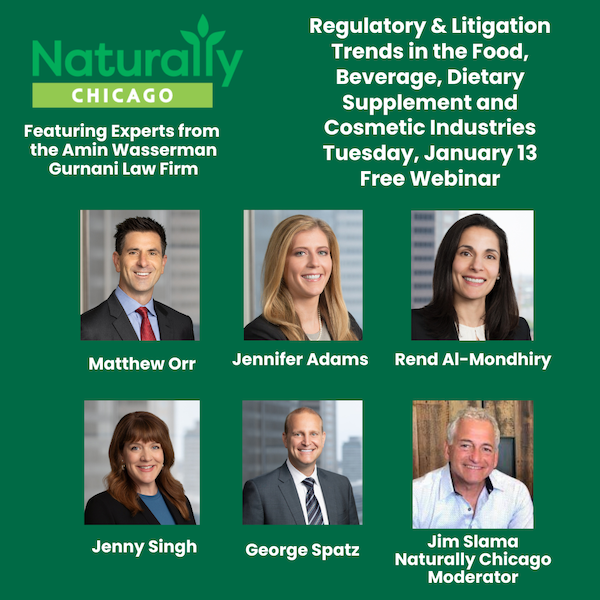
To illuminate these issues… and how businesses should approach them… Naturally Chicago on January 13 presented its webinar, “Regulatory and Litigation Trends in the Food, Beverage, Dietary Supplement & Cosmetic Industries.” The webinar featured the following five experts from Amin Wasserman Gurnani, a law firm acknowledged as a national leader on regulatory and litigation issues:
Rend Al-Mondhiry on regulatory updates and trends at the FDA and states
Jennifer Adams on advertising law and National Advertising Division (NAD) updates and trends
George Spatz on commercial disputes, claims and remedies
Matthew Orr on class action trends and strategies on prevention and defense
Jenny Singh on Proposition 65 trends and strategies on prevention & defense [Note: California Proposition 65, enacted by state voters in 1986, protects the state's drinking water sources from being contaminated with chemicals known to cause cancer, birth defects or other reproductive harm, and requires businesses to inform Californians about exposures to such chemicals. Businesses, including those based outside California, must meet Prop 65 requirements in order to sell products in the state.]
Rakesh Amin, co-founding partner of the firm, is a member of the Naturally Chicago Board of Directors.
Jim Slama, Naturally Chicago Managing Director, moderated the conversation.
The following are highlights and takeaways from the information-packed, hour-long discussion. To take a deeper dive, we recommend that you click the button below to access the video recording of the webinar.
LANDSCAPE OVERVIEW
(REND AL-MONDHIRY)
CURRENT LANDSCAPE
The Trump administration’s “Make America Healthy Again” agenda has accelerated focus on food chemicals, colorants, ultra-processed foods and childhood health.
Staffing changes and cutbacks in the administration’s Department of Health and Human Services and Food and Drug Administration Agency raise capacity questions; enforcement may shift to states or private litigation in some areas.
States remain active and often take the lead on restrictions (colors, heavy metals, PFOAs, school bans, Extended Producer Responsibilities programs).
2025-26 TOPIC WATCHLIST
“Generally Recognized as Safe” (GRAS) pathway: proposed rule expected to curtail self-affirmed GRAS pathway; potential requirement to file GRAS notices and likely industry pushback.
Food dyes/colorants: post-market assessments ongoing; revocations proposed (e.g., Red No. 3 revoked; Orange B proposed); voluntary industry phase-outs occurring.
Front-of-package nutrition labeling: final rule anticipated.
Dietary supplement updates: expected rulemaking regarding a specific ingredient (N-acetylcysteine) and possible clarification on NDINs (New Dietary Ingredient notifications) — long-awaited guidance may appear in late 2026.
Ultra-processed food definition: potential joint FDA/USDA work; states taking the lead (California “ultra-processed foods of concern” actions).
Cosmetics/MOCRA implementation: incremental guidance expected (fragrance/allergen issues, GMPs later).
Heavy metals and infant/prenatal products: states (notably California) enacting testing/disclosure laws beyond federal actions.
Extended Producer Responsibility (EPR) and PFAS/PFOA restrictions: growing state-level activity with varied deadlines and requirements.
PRACTICAL TAKEAWAYS
Monitor the GRAS proposed rule closely; be prepared to comment.
Track state-level restrictions — they may outpace federal enforcement.
Review ingredient portfolios for colorants, synthetic ingredients and heavy-metal risks; test and document.
“We expect aggressive state-level activity and a controversial GRAS proposal. Industry should be ready to engage and document.” — Rend Al-Mondhiry
ADVERTISING, AI, AND NAD/FTC ENFORCEMENT
(Jennifer Adams)
AI in advertising is now a material legal/regulatory risk: AI-generated “performers,” synthetic doctors, and imagery require careful disclosure and oversight.
New York (and other states) are moving to mandate disclosure when synthetic performers are used; expect more state-level AI disclosure laws.
Subscription auto-renew enforcement remains a top FTC priority; major settlements and ongoing actions headline this area (e.g., Amazon Prime settlement precedent).
Pricing and discount claims (reference pricing, false urgency) and green/ESG claims continue to be scrutinized by NAD, state AGs and competitors.
PRACTICAL CONTROLS
Create/maintain an AI use policy; require vendors/agencies to disclose AI creation and provide provenances.
Audit subscription enrollment and cancellation flows; ensure affirmative consent and easy cancellations; comply with California’s subscription rules.
Document substantiation for pricing, reference pricing and environmental claims; avoid vague greenwashing language.
Monitor NAD decisions — they remain influential even where the FTC’s priorities shift.
ENFORCEMENT POSTURE
FTC focusing on “kitchen table” issues (consumer harm from surprise charges and opaque subscriptions).
NAD remains active in dietary supplement claims and structure/function consistency.
“You need to know where you’re using AI in your ads. Implement AI policies now, or risk regulatory and reputational fallout.” — Jennifer Adams
COMMERCIAL DISPUTES, CONTRACTS AND MARKETPLACE ENFORCEMENT
(George Spatz)
COMMON DISPUTE DRIVERS
Contract breach and warranty claims across suppliers, manufacturers and brands; UCC Article 2 governs many disputes involving goods.
Battle of the forms: unreviewed purchase orders, acknowledgements or website terms can bind parties inadvertently.
Express warranties from product descriptions create litigation hooks; implied warranties (merchantability) remain powerful absent contractual waivers.
Recalls often tie back to contractual clauses requiring compliance with laws and GMPs (21 CFR Part 117 for food; Part 111 for supplements).
MARKETPLACE DISPUTE STRATEGIES
UCC remedies (which include incidental/consequential damages) can substantially increase exposure; inspect clauses and limits in contracts.
Distributor “John Doe” suits and subpoena strategies are increasingly used to locate unauthorized sellers in marketplaces.
Domain and marketplace abuse: UDRP, takedown requests, temporary restraining orders and platform-specific infringement complaints remain tools to combat counterfeit/squatting/mirrored sites.
PRACTICAL CONTROLS
Review procurement and sales paperwork for incorporation of clauses; object promptly if terms are unacceptable.
Make specifications and product descriptions precise to limit express warranty risk.
Include indemnity and recall allocation terms with suppliers and co-packers.
Use contractual controls and IP enforcement tactics to limit unauthorized marketplace sales.
“Don’t let boilerplate purchase orders or website terms create surprise obligations. Review and object early.” — George Spatz
CLASS ACTION LITIGATION TRENDS AND PREVENTION STRATEGIES
(Matthew Orr)
HIGH VOLUME CLAIM AREAS
Contaminant/micro-contamination claims (lead, cadmium, arsenic), often tied to products sourced from soil (proteins, seeds, spices).
Label/ingredient claims: “all natural,” flavor claims involving acids (citric/malic/ascorbic), sugar claims in kombuchas, and percent protein/percent DV disputes (plant proteins require digestibility adjustments).
Slack-fill packaging suits remain pervasive; courts recently letting more past motion-to-dismiss.
Website/data privacy cases (metapixel, trap-and-trace IP capture) and email spam/misleading subject-line statutes emerging.
Subscription/auto-renew litigation and mass arbitration risks.
MITIGATION STRATEGIES
Regular, independent product testing (lot-by-lot where feasible) rather than relying solely on supplier COAs.
Clear labeling: avoid absolute terms (“pure,” “clean”) unless defensible; use nuanced claims (e.g., “made with X% U.S. ingredients” rather than blanket “Made in USA”).
Packaging transparency: fill lines, serving counts and disclosures reduce slack-fill exposure.
Arbitration clauses with anti-mass-arbitration “poison pill” provisions; careful drafting to avoid making problems worse.
Cookie consent and privacy compliance: ensure pixels are not active before opt-in.
LITIGATION POSTURE
Plaintiffs seek claims that survive minimal pleading thresholds; robust pre-litigation documentation and testing reduce vulnerability.
“Testing and defensible labeling are your best weapons. Don’t rely on supplier certificates alone.” — Matthew Orr
PROPOSITION 65 TRENDS AND DEFENSE
(Jenny Singh)
CURRENT LANDSCAPE
Prop 65 continues to target food, beverage and supplements; heavy metals (lead, cadmium), PFAS/PFOA, phthalates (packaging), and chemicals in receipts/thermal paper (BPS/BPA) remain key targets.
Plaintiffs increasingly use retailers to ensnare small businesses; small business exemptions are being navigated aggressively by bounty plaintiffs.
OEHHA’s short-form warning amendments (compliance deadline January 2028) broaden required content and now formally cover food/dietary supplement short-form usage.
No safe harbor for many PFAS chemicals — absence of bright-line levels complicates defense.
DEFENSIVE MEASURES
Conduct exploratory and lot-level testing aligned to serving sizes and consideration of plaintiff’s consumption assumptions versus regulatory guidance; compare to Prop 65 safe harbor numbers where available.
Evaluate supplier testing and certifications; review upstream defense and indemnification clauses.
If warnings are used, ensure they follow clear and reasonable Safe Harbor formats (placement, size, language) and are present both on product and online (OEHHA guidance).
Promptly contact counsel when a 60-day notice is received; ignoring a notice may increase risk and litigation consequences.
PRACTICAL ADVICE
Treat Prop 65 as risk management: testing, documentation, supplier controls, and clear warnings/communications reduce litigation risk.
“Prop 65 is less about absolute compliance and more about risk management. Test where appropriate, document, and don’t ignore notices.” — Jenny Singh
CROSS-CUTTING PRACTICAL RECOMMENDATIONS
(Panel Consensus)
Audit and document: ingredient sourcing, testing data, supplier contracts and marketing substantiation.
Policy formation: AI and advertising policies; subscription and cancellation SOPs; privacy/cookie governance.
Contractual rigor: update purchase orders, warranties, recall clauses, indemnities and marketplace controls.
Litigation preparedness: establish testing protocols, arbitration strategy with anti-mass-arbitration language, and recall playbooks.
Regulatory watch: subscribe to regulatory roundups, engage in rulemaking comments (GRAS; labeling; dietary supplement guidance), and monitor state actions.
“Between federal rulemaking, aggressive state activity, and creative private litigation, companies must document, test, and tighten both commercial and marketing practices to manage regulatory and litigation risk.” — Panel Consensus