
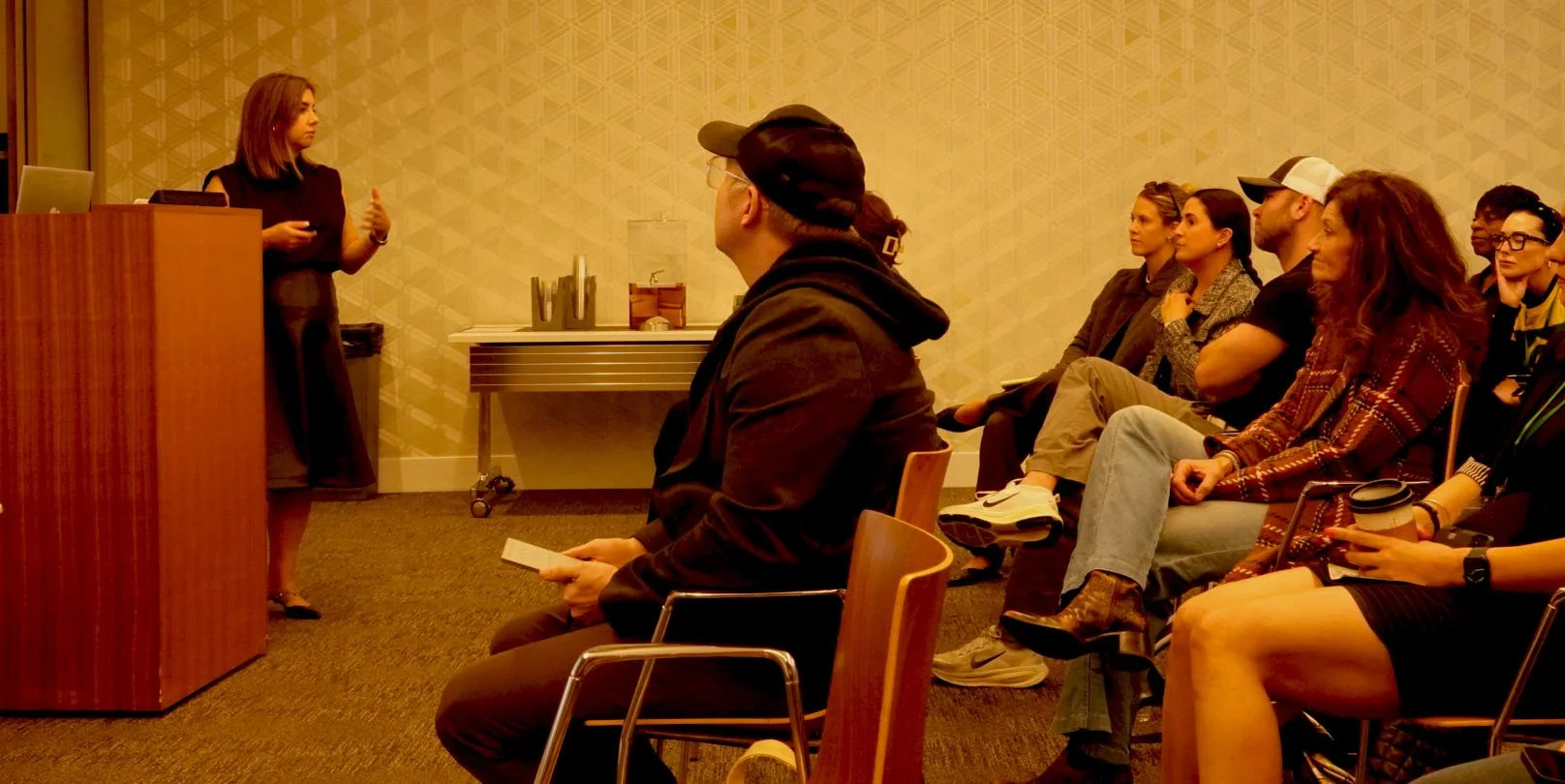
Julia Foxworthy, vice president of innovation at Mattson, explains the company’s innovation process to attendees at Naturally Chicago’s Innovation and Product Development Intensive on Nov. 6. Photo by Bob Benenson
Mattson’s Julia Foxworthy on Innovation: Solving a Consumer Problem — and Doing It Differently
Case studies from Kindling to Rao’s to Ripple anchored the opening presentation at Naturally Chicago’s Innovation and Product Development Intensive on Nov. 6
Innovation is not newness for the sake of newness, not another flavor and not a one-time launch, Julia Foxworthy, vice president of innovation at Mattson, told an audience of emerging food and beverage brand founders at Naturally Chicago’s Innovation and Product Development Intensive.
“Innovation at the core is really about solving a consumer problem,” Julia said. “But it’s not enough to solve a consumer problem. It has to be meaningfully different, and it has to tie back to your brand’s promise. It has to all make sense.”
Julia led off the event, which was held November 6 at Bank of America’s Chicago headquarters. It was the second part of Naturally Chicago’s three-part CPG Growth Series, following last month’s Capital Readiness Workshop. The third installment, focused on women in CPG, is set for Dec. 10 at BMO Tower and will feature Lifeway CEO Julie Smolyansky, among others.
Julie was introduced by Jim Slama, CEO and Founder of Naturally Chicago, which now counts 160 member brands that are mostly early-state to emerged. Jim said innovation and product development is “a really important topic, especially for emerging brands.”
Mattson, along with Whole Foods Market, Truli and Bank of America were among the event’s partners.
Went Big, Now Grows Small
Julia said she has been building brands for a long time, though she is not a founder. Previously she spent more than a decade with big companies, at Constellation Brands leading the innovation team for beers including Corona and Modelo, and before that at General Mills and Kraft.
She joined Mattson this past April. Based in the San Francisco Bay Area near Silicon Valley, Mattson has been around for 50 years.
The employee-owned company has about 60 staffers, a handful of them in Chicago, and works with clients on food and beverage innovation “from strategy all the way through commercialization,” Julia said. Its clients range from large CPG companies to founder-led and early-stage brands.
The Cost of Standing Still
Julia Foxworthy. Photo by Bob Benenson
For founders wondering whether innovation is worth the expense and effort, Julia offered a blunt answer: I you don’t, “Someone else will.”
She cited several once-dominant brands that were slow to respond as protein became a dominant consumer trend. SlimFast, which she said once had sales of $2.5 billion, was sold to Glanbia for a fraction of that peak value. Yoplait, she said, was a victim of Greek yogurt’s rise — and she recalled sitting in General Mills meetings where executives dismissed Greek yogurt as too niche and too “funky tasting.” Dean Foods, a milk powerhouse, was upended by Fairlife in a category long viewed as stale.
There are good and bad reasons to launch a new product, Julia said. A competitor’s launch, excess capacity, or a request from a retailer to fill a shelf slot may prompt action, “but it has to make sense.”
Even in food and beverage, where products are about “moments of joy and celebration and connection,” innovation should offer a meaningful improvement in consumers’ lives — better, faster or cheaper, with “cheaper” meaning more value for the dollar rather than a lower shelf price.
Julia also noted that four in 10 SKUs are gone within two years, and 25 percent within one year. A frequent reason, she said, is that brands have a strategy but don’t stick to it, lacking a long-term plan for how innovation fits their brand story.
Open Book Test for Founders
Julia said there are only three levers for growth: more buyers (reach), more occasions (frequency) and more shelves (availability). She translated those into three questions founders should ask themselves.
Who isn’t buying us yet, and why not?
Nearly three of four brands grow by adding household penetration rather than selling more to existing customers, Julia said. Consumers of smaller brands tend to be less loyal, so the goal is to bring in new consumers and then build loyalty.
New buyers may be the same people at a different point in their lives or days, or reached through a new format or price point. She cited Graza’s squeeze-bottle olive oil as a format innovation that brought new buyers into a category while converting existing ones.
Mattson’s examples included Kindling, a protein-packed pretzel developed with Cameron Smith, co-founder of Kodiak, who wanted to repeat the “magic” of reinvigorating a sleepy category — pancake mix in Kodiak’s case — by making it healthier yet approachable. Mattson helped Cameron settle on pretzels (Americans eat two pounds per person each year), tested dozens of protein combinations for texture and taste, identified co-manufacturers and ran factory trials. Kindling became an Amazon bestseller and doubled the pretzel category on Amazon within months of launch, Julia said.
Happy Family, parent of Happy Baby, had built a $13 million business on pouches but faced the challenge that babies age out of the category. Over three years, Mattson and the company developed almost 70 SKUs — bars, cookies, drinks, Greek yogurt pouches and meals — to keep families in the brand as children grew. Revenue quadrupled to about $60 million, and Danone acquired a majority stake in 2013.
When else can we show up?
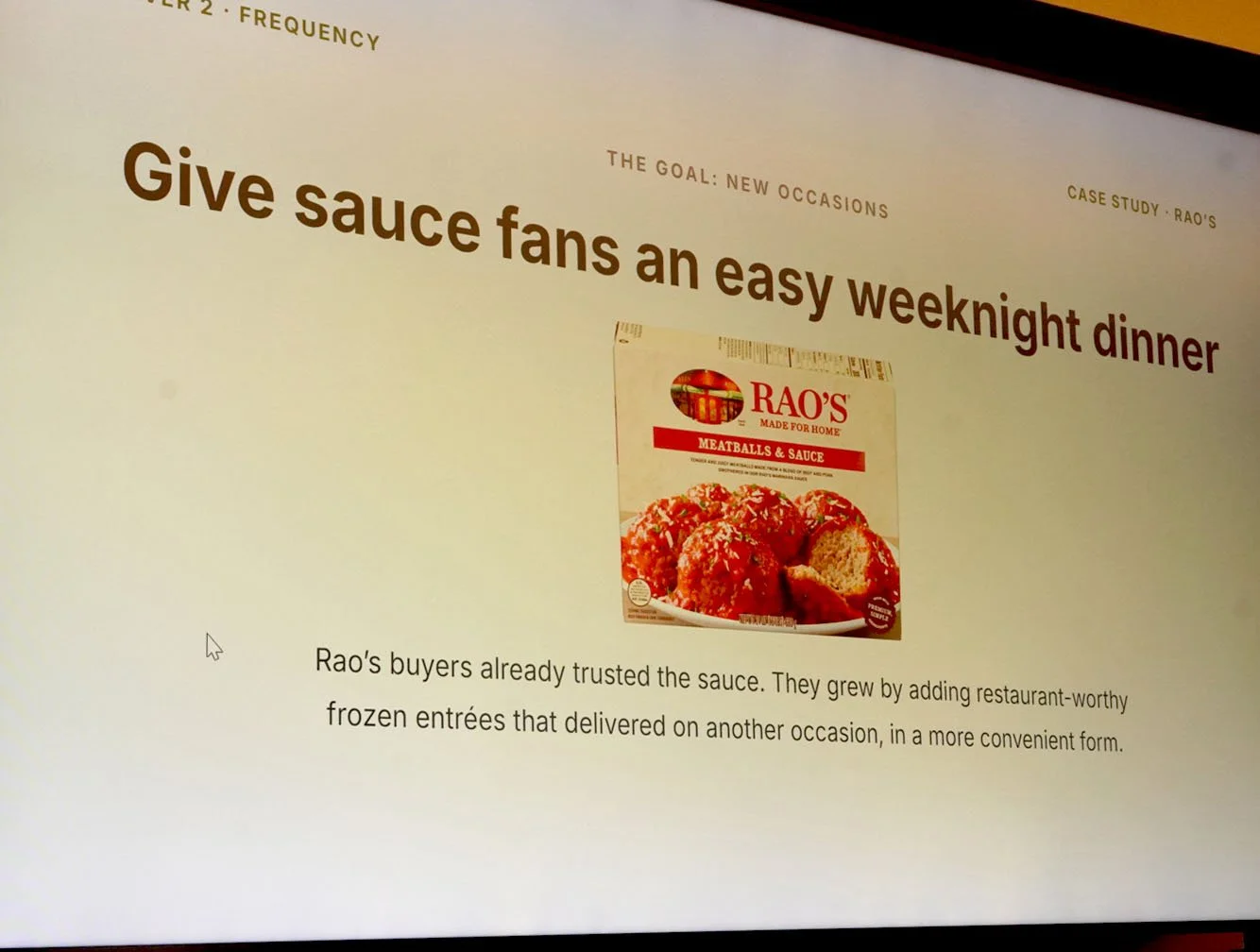
Photo by Bob Benenson
Julia cautioned that “more flavors are not a frequency strategy.” Consumers tend to pick a favorite flavor, perhaps one other, and stick with them. Frequency comes from understanding when and why consumers use a brand, then asking where else it could travel.
Rao’s, the sauce brand that began as a New York restaurant, was owned by Sovos when the company brought Mattson in as essentially its outsourced R&D arm in 2017. Consumer insights showed the brand was loved but that on weeknights people didn’t want to boil and drain noodles. Mattson helped Rao’s develop frozen entrées — meatballs, lasagna and chicken parmesan among them — and tested to ensure quality held up through freezing and reheating.
That part of the business grew almost 50 percent, Rao’s reached $750 million in sales by 2023, and Campbell’s acquired Sovos for nearly $3 billion.
Noosa, another Sovos brand, knew that about half of yogurt consumers add toppings and wanted a convenient way to do so, in order to take yogurt into the afternoon snacking occasion. Mattson explored base flavor and topping pairings in a workshop (“we ate a lot of yogurt,” Julia said), built the varieties and found a co-packer for the toppings. Sales and market share tripled, with launches at Kroger, Target and Whole Foods Market.
Where are people looking for us and not finding us?
Three-quarters of U.S. consumers will switch brands if their preferred one isn’t available, Julia said, and the average household shops almost 40 retailers. But that doesn’t mean a brand should be everywhere. “Better to be fewer places well supported than stretched too thin,” she said, adding that products can be designed for specific channels.
Blue Bottle Coffee — which began as a cart in Oakland, California — came to Mattson with cafés but no retail presence. Mattson helped develop the now-familiar milk-carton-style cold brew format (a challenge because coffee’s acidity can attack packaging linings) along with a mini=can, and led plant trials.
The products launched at Expo West in 2014 and then at Whole Foods, and in 2017 Nestlé bought nearly 70 percent of the company for about half a billion dollars.
Ripple Foods came to Mattson as “two guys with an idea and a little bit of money.” After Mattson helped create its pea-protein milk, the team reasoned that many dairy-free consumers never walk down the milk aisle, and developed plant-based ice cream, frozen yogurt and soft-serve base, with consumer feedback shaping each step.
Ripple debuted five flavors at the Sprouts Farmers Market grocery chain, won a National Restaurant Association award in 2022, and raised a Series E in part on the strength of the new products.
Framework for Founders
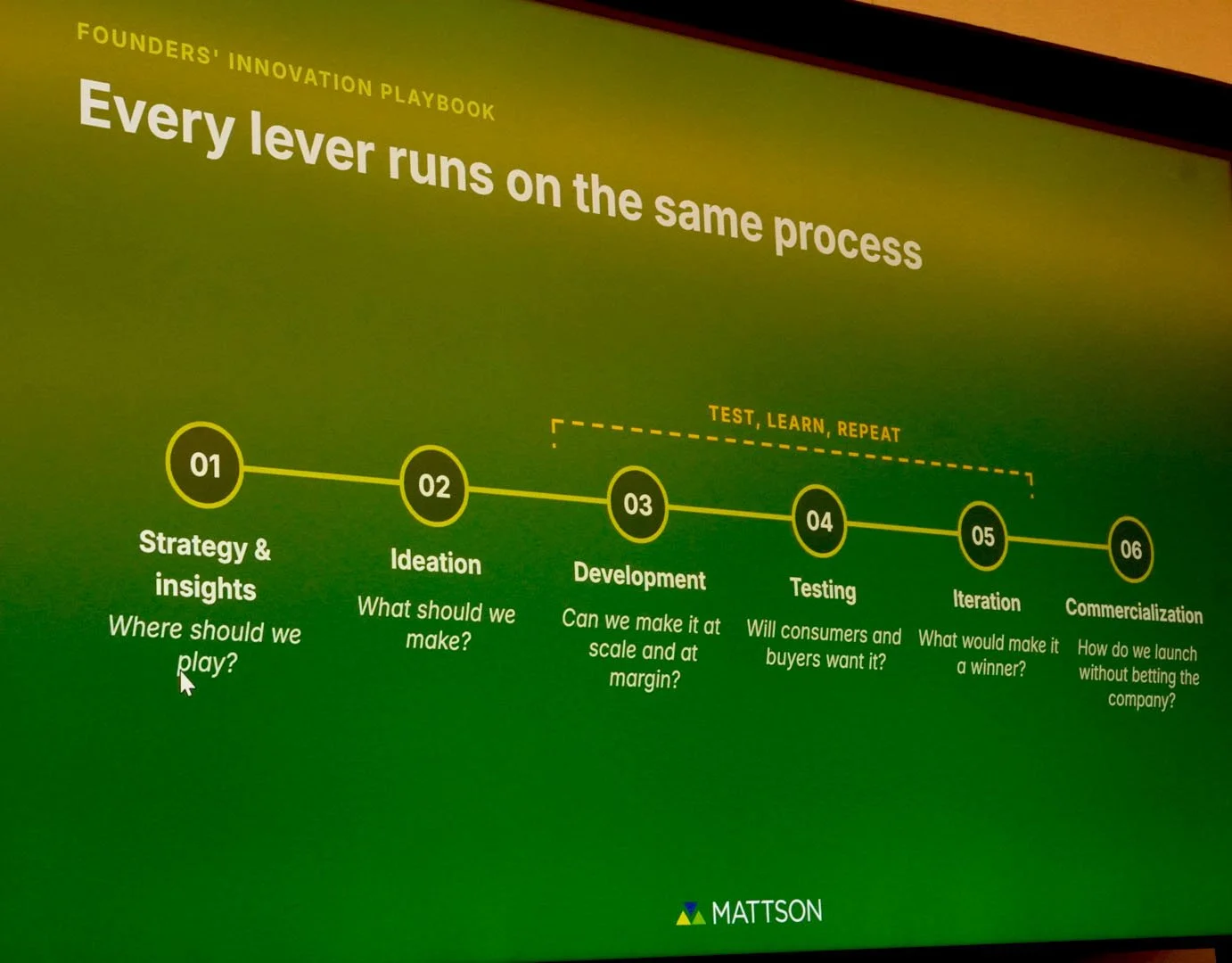
Photo by Bob Benenson
Julia said good innovation starts with “insights, insights, insights” about who consumers are and what problems they need solved, followed by ideation, development, testing, iteration and commercialization. Mattson’s tools include consumer segmentation, focus groups, in-studio cooking sessions, shop-alongs and AI-powered consumer, retailer and chef personas, plus a panel of chefs mostly based in Chicago.
She urged founders to start with a diagnosis of how well they know their brand, define the growth objective innovation is meant to affect, and set a time frame for measuring success and “know when to walk away.” Julia said it is acceptable if an effort doesn’t work the first time, but a framework prevents “endlessly spinning in the innovation cycle.”
Her bottom line: “Pick one, make something great, support it adequately and consistently” and prove the success, which then becomes a story to tell retailers.
Audience Questions
Jim asked about companies whose innovation fell short. Julia said many clients are on a second or third iteration after something didn’t hit in the market, and that others, like Cholula — which Mattson helped reformulate toward a cleaner label before McCormick acquired it — simply hadn’t touched a beloved legacy product in years. The key, she said, is knowing how far to push without losing what makes a brand special.
Asked whether true product innovation or marketing matters more, Julia said she is biased but believes the best innovation is at the product level. “You can buy trial through marketing, and you can buy interest, but it is really, really hard to buy loyalty,” she said.
Brittany Martin identified herself as founder of SwimClean, a category-starting skin and hair care line for swimmers, and asked whether a second SKU should also be a category starter. Julia advised including something familiar, because shoppers spend perhaps 10 to 12 seconds at the shelf and need to grasp immediately what a product is and how it fits their day. Placement next to a similar product or clear front-of-pack information can help, she said.
Another attendee asked about Mattson’s team diversity. Julia said the team is majority female and about half have culinary or technical backgrounds, including food scientists and restaurant veterans, while others came from big CPG and even Disney’s hospitality insights group. More important, she said, is bringing consumers themselves into the process early so that diverse consumer perspectives are represented.
Finally, Angelina Froes of Nina’s Noms — a maker of frozen Brazilian cheese bread — said she is rebranding and asked how to balance authenticity with broad appeal. Julia said consumers can tell whether a story is authentic, so brands shouldn’t lose that, but should also connect to an existing behavior or format that offers “a little spark of familiarity.” She pointed to the momentum of Korean flavors on fried chicken, an American staple, as an example.