
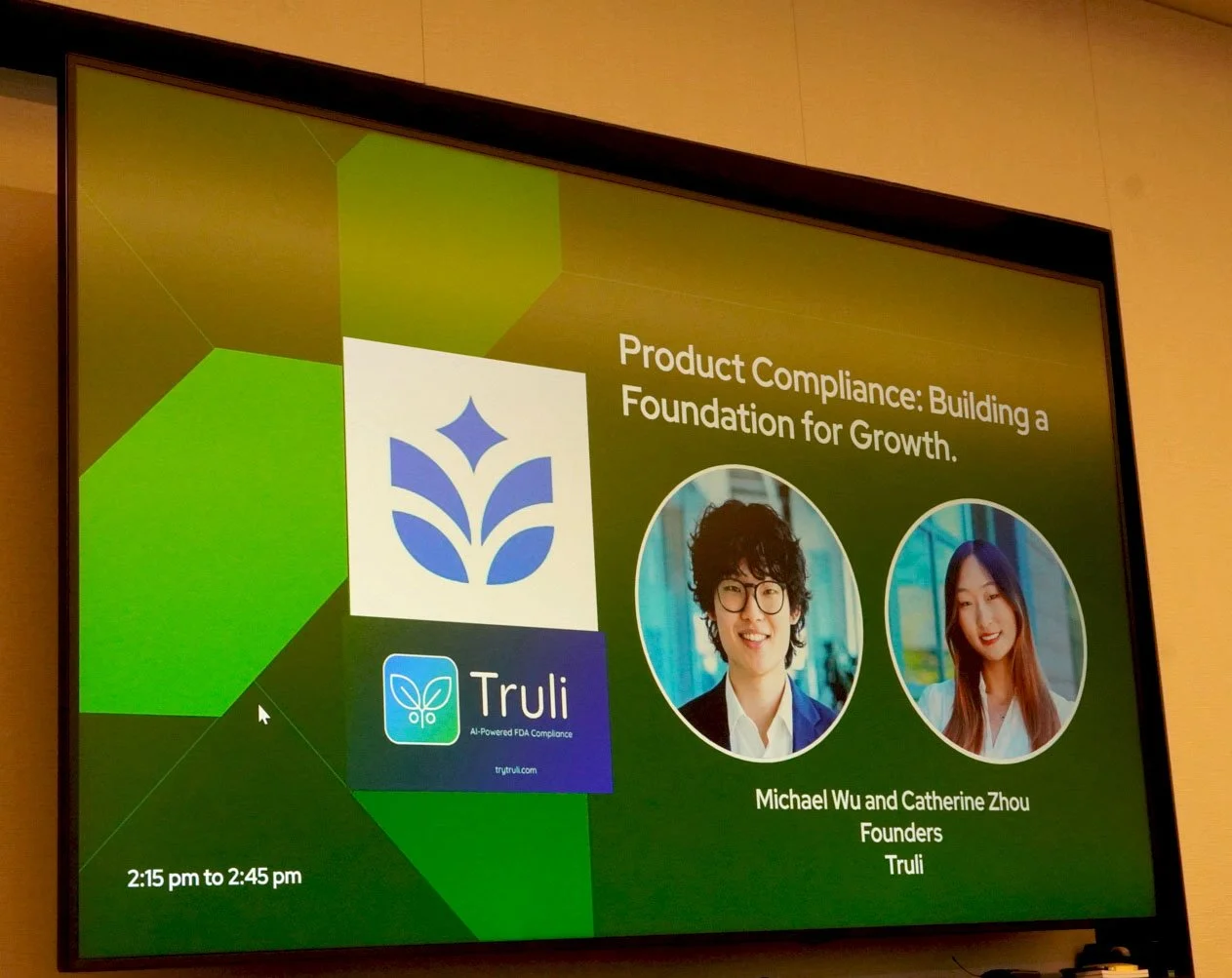
Photo by Bob Benenson
Truli’s Catherine Zhou: Treat Compliance as a Growth Tool, Not a Roadblock
At Naturally Chicago’s Innovation Intensive, co-founder says Truli’s AI-powered platform catches labeling and marketing problems earlier and at lower cost
Regulatory compliance is too often treated as the last hurdle before a product launch, but companies that build it into every stage of development can avoid expensive reformulations and market their products more effectively. That is how Truli Co-Founder Catherine Zhou told attendees at Naturally Chicago’s Innovation and Product Development Intensive.
Catherine spoke in the second segment of the Nov. 6 event, held at Bank of America’s Chicago headquarters. The program was part 2 of Naturally Chicago’s three-part CPG Growth Series. She co-founded Truli — based in the San Francisco Bay area — in January with Michael Wu.
Truli uses an AI-powered platform to help food, supplement and other consumer brands streamline compliance with government regulations. Catherine said regulatory problems can undo a company’s innovation work. “Today there are also a lot of regulatory challenges that can actually undo a lot of your work,” she said, following upon an earlier presentation on product innovation by Julia Foxworthy of the Mattson company.
What FDA Enforcement Shows
Catherine began with her company’s review of this year’s U.S. Food and Drug Administration (FDA) enforcement patterns. Among the findings:
31 percent of the food recalls Truli reviewed involved undeclared allergens. “Some of the most basic issues are still getting caught,” she said.
44 percent of FDA warning letters referenced product or marketing claims on a company’s own website or online listings.
48 percent of warning letters involved misbranding.
When FDA cited disease claims in a food or supplement warning letter, 96 percent of those letters also quoted the company’s website.
Catherine said the data shows that compliance extends well beyond the package. Marketing materials, social media and every other channel where a product is sold or promoted needs to be aligned and compliant, she said.
She also noted several regulatory changes on the horizon. FDA proposed mandatory notification for GRAS (generally recognized as safe) ingredients in August, which would require companies to publicly disclose safety determinations that can now be made privately. Public comments on the proposal close December 9.
A federal definition of ultra-processed foods is under review. Catherine cited a University of Chicago study estimating that 72 percent of packaged foods would have to redo their designs based on the current discussion on the issue, at a cost of about $14 billion.
And it isn’t just about federal regulations. States are advancing their own restrictions on ingredients such as food dyes, chemicals and added sugars, with legal uncertainty surrounding some of them. Catherine pointed to the warning label law in Texas and court challenges to West Virginia’s dye ban.
Her advice was for companies to identify their self-affirmed GRAS ingredients, any products containing restricted additives, and the states where they plan to sell.
Changing the Question
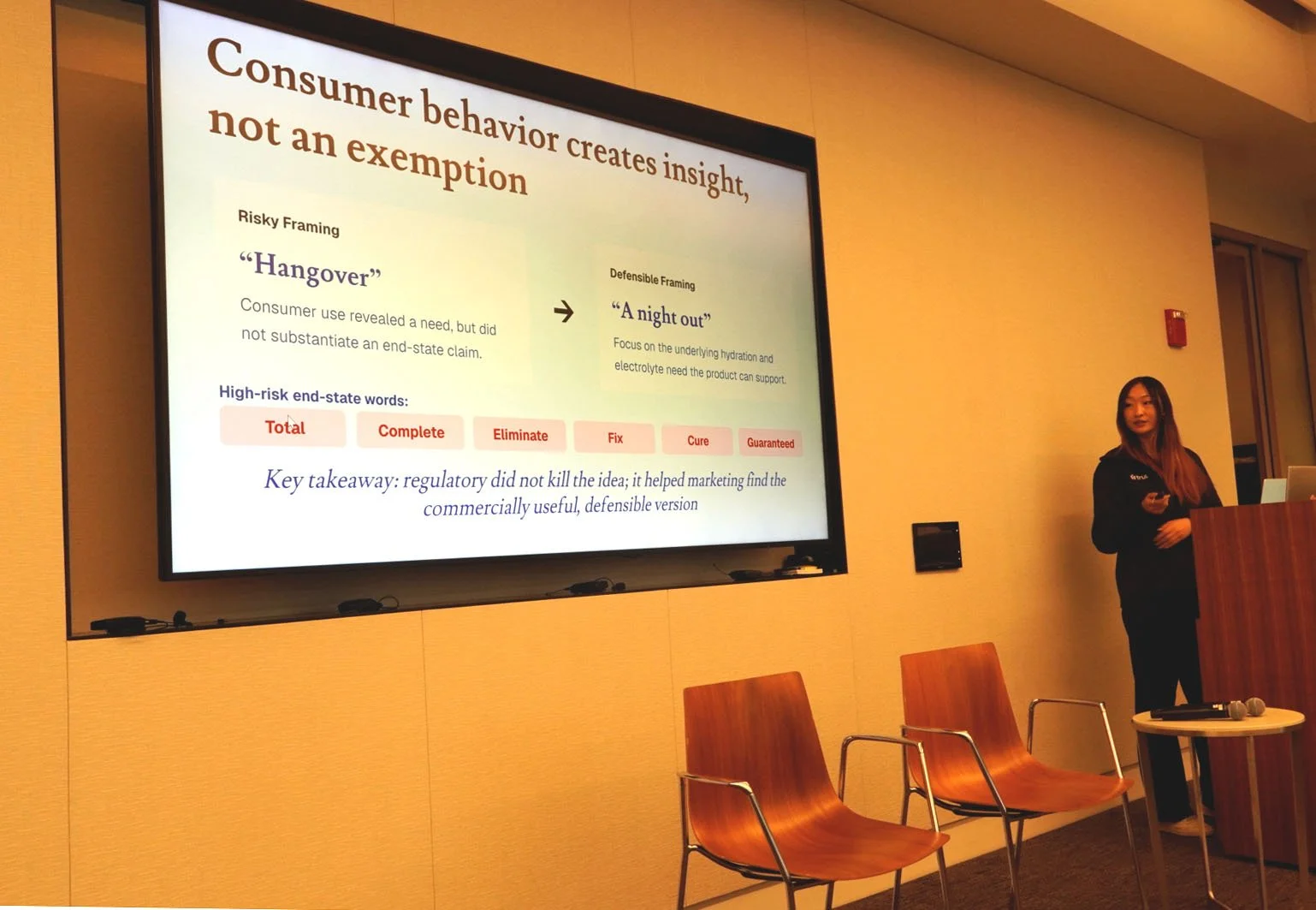
Photo by Bob Benenson
Catherine said companies often see regulatory teams as “the police” or the department that says no. She argued that their real value is knowing the rules and showing their business where the boundaries are and where there is room to innovate.
“Instead of asking, ‘Can we say this?’ the better question is to ask, ‘What can we say, and how can we support it?’” she said.
She illustrated the point with Liquid IV, a company where one of Truli’s regulatory directors previously worked as a senior regulatory manager. Consumers were using the hydration product after drinking, which made hangovers a tempting marketing angle. But FDA treats alcohol intoxication as a disease and hangovers as a symptom, so hangover claims could raise unapproved drug claim issues. The company instead positioned the product around a “night out.”
That approach kept the underlying consumer need, hydration and electrolytes, without the medical claim, and it widened the market, Catherine said, because a night out could mean dancing, a concert or staying up late playing video games.
She also cautioned against absolute language such as “total,” “complete,” “eliminate,” “fix,” “cure” and “guaranteed.” And she said evidence that an ingredient such as vitamin C provides a benefit doesn’t mean the finished product delivers the same benefit, because dose, formulation and ingredient interactions matter. Claims need to be supported by studies, including ones with negative results, and must be consistent across packaging and social media.
Planning for More Than One Market
Catherine said startups and larger companies alike often plan “when you get there” to deal with selling in California, retailers or international markets She noted that businesses want to avoid reformulating and recommercializing the same product to move into new markets.
“The label is really the end of a much longer chain,” she said, adding that decisions on ingredients, sourcing and formulation can create costly problems downstream.
She noted that national brands generally don’t want a California-only product or a Prop 65 warning on every package, so they look to address issues across the supply chain. Proposed restrictions in California and New York matter even if they don’t pass, because states watch each other and the same ingredient restriction can surface elsewhere. Retailers such as Costco and Whole Foods Market have their own requirements that should be understood before packaging is created.
International rules can vary widely, too. Liquid IV, for example, is classified as a food in the United States, a fortified food in Canada, a dietary supplement in the European Union and a medicine in Australia.
Making Regulatory a System
Going from 20 products to 500 doesn’t mean hiring 25 times as many regulatory staffers, Catherine said. Instead, regulatory has to become a system with four elements:
Ownership. Regulatory should typically sit under quality, legal or R&D, but with enough independence and authority to make decisions.
Risk-based reviews. Not everything needs the same scrutiny. At Liquid IV, she said, the regulatory team once found itself reviewing napkins for a launch party because they carried the company logo. The team then established a rule that materials using only approved imagery or information already on packaging don’t need another full review.
Self-service tools. Approved claim libraries, templates and clear guidelines let marketing, R&D and sales answer routine questions without waiting for regulatory.
Durable infrastructure. Companies should replace spreadsheets and ad hoc folders with systems that scale as new products are developed.
Catherine said every team has a role. R&D should recognize regulatory risks while evaluating ingredients, and marketing should bring regulatory in as ideas develop rather than after a campaign is finished. Sales needs approved answers to retailer questions, and legal needs to stay aligned on enforcement exposure and accountability. Smaller companies can assign these roles to one person or an outside consultant, she said.
She also said regulatory should help executives make decisions, particularly in acquisitions. She recommended a red, yellow and green traffic-light system, noting that in most acquisitions, “everything is yellow.” In one review, she said, the findings ran to 170 pages, but leadership received a single page covering regulatory impact, cost and time to fix, potential upside and downside, and a clear recommendation.
How Truli’s Platform Works

Photo by Bob Benenson
Catherine then described Truli’s product, which is designed to support compliance throughout the product lifecycle instead of through point-in-time manual reviews. The company’s specialized AI agents review labels much as a regulatory team would, she said, routing inputs such as packaging, ingredients and formulation to the relevant regulations and producing findings with citations, reasoning and suggested fixes.
In a demonstration using packaging pulled from online, the system flagged a “50 percent less fat” claim that lacked a quantitative comparison, a potassium rounding issue, and a misspelling of “starch.” Catherine said a scan takes about five minutes.
The platform also reviews social media content, retailer listings and ads, including affiliate videos on TikTok, YouTube and Meta. It can generate compliant marketing content and monitor channels after launch. In one example, it found a non-compliant claim in 18 TikTok posts and recommended taking them down.
Truli’s database includes about 200,000 regulations, along with enforcement and litigation signals that it ingests hourly, Catherine said. That means a notice about an ingredient being banned in a state would surface as soon as it enters the system.
Pricing is currently highly affordable, about $500 per product per year, plus a $1,000 platform fee. The platform offers flexible pricing based on product portfolios and regulatory complexity. Costs rise with product complexity, such as selling in additional countries.
Questions from the Audience

Photo by Bob Benenson
Responding to questions, Catherine said the system identifies missing label elements as well as errors, and checks formatting and boldness. She said it also can adapt a U.S. label for other jurisdictions, such as Canada, including translation and the addition of required elements.
On recalls, she said the issue is largely one of traceability, which also depends on ERP systems. If a company has lot numbers recorded and has uploaded supplier and manufacturer compliance documents, Truli can help trace the lots involved, she said, but that depends on those records being in place.
Asked how Truli differs from certification bodies that conduct manual label and legal reviews, Catherine said the certifications provide a view of what needs to change at one point in time. Truli aims to let companies know in advance what might be non-compliant, so they avoid a long list of fixes at certification.
Asked about her motivation, Catherine said she had run her own iron supplement company and dealt with FDA, lawyers and consultants. With a computer science background, she developed the product with her co-founder while they were still in school. Truli is backed by Andreessen Horowitz's early-stage fund and now works with a number of large brands.
On social media enforcement, Catherine said the biggest practical risk is often having an account banned by Meta, which can devastate sales. Other consequences include reputational damage and lawsuits from plaintiff lawyers or competitors. She said content tied to a company, such as through an ad disclosure or hashtag, can make the brand liable, so affiliate content needs to be compliant. Unpaid influencer posts fall into a gray area, she said, but brands should avoid situations in which an influencer is sued and points back to the brand’s similar claims.