
Growth and Disruption Trends for Natural Brands & Retailers 2026 — 12/4/25 Webinar
2026 Consumer Food Trends Webinar: Conscious Consumption Comes of Age
There are ample reasons for concern about the overall U.S. economy — inflation, tariff uncertainty and constant disruptions among them. But we have good news: consumer demand for natural, organic and functional foods continues to outpace conventional products.
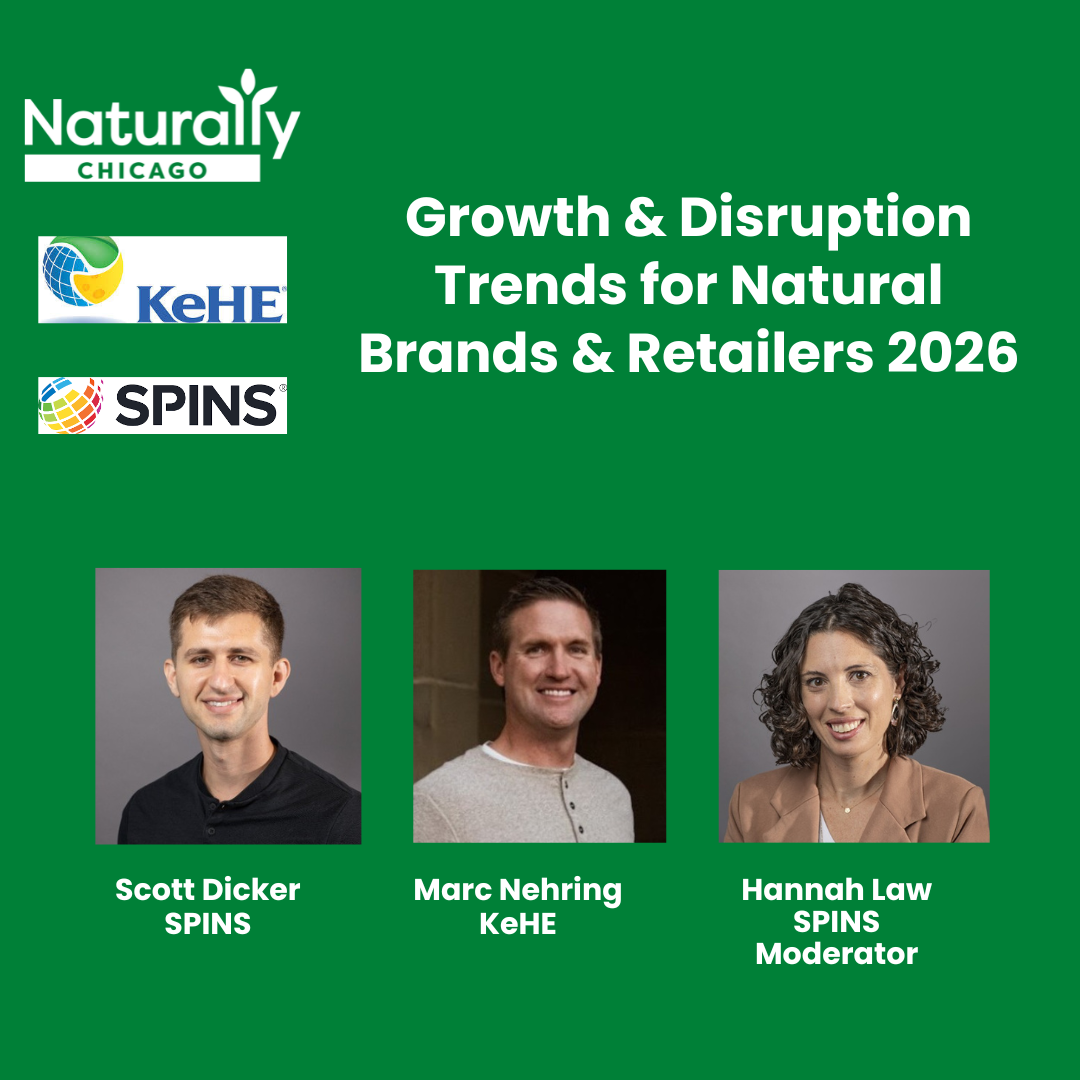
Leaders from SPINS and KeHE Distributors laid out an evidence-based view of what’s next during Naturally Chicago’s December 4 webinar, “Growth and Disruption Trends for Natural Brands & Retailers 2026." Their core message: conscious consumption is no longer a niche: It’s the organizing principle of how younger, informed shoppers build their baskets — and it’s reshaping everything from ingredient decks to digital shelves.
“Shoppers of natural products just aren’t pulling back in the same way. They’re much less price sensitive, and they’re committed to the attributes we’re going to talk about today — clean labels, sustainability, and functionality,” said Marc Nehring, Director of Growth Solutions — Dedicated Accounts at KeHE, the largest distributor of better-for-people-and-the-planet products.
He was joined by Scott Dicker — Senior Director of Market Insights at SPINS, the leading provider of data and insights for the natural products industry — in a deep-dive discussion moderated by Hannah Law, SPINS’ Senior Vice President and Chief of Staff.
This article is packed with takeaways, but to get the bigger picture, please click the button below to access the webinar video.
Our colleagues at SPINS and KeHE have also generously shared their information-packed slide deck shown during the webinar. Click the following button to access.
Stability Amid Disruption
Before diving into trends, the panel grounded the conversation in macroeconomic reality.
Inflation and Resilience in Natural
Over the past six months, food inflation has now outpaced overall U.S. inflation.
Yet: Unit growth in natural & specialty products is holding at roughly 4 percent year over year.
That is more than double the unit growth in conventional products, which is closer to 1.5 percent.
So who are the Natural sector’s core consumers? They skew:
Younger
Higher income
More diverse
More urban
And more values-driven
Marc Nehring summed up, “With that in mind, at KeHE, we remain very bullish on 2026 for natural and organic products.”
Price Increases: Delayed but Inevitable
SPINS data shows that price changes move more slowly than headlines:
It typically takes 12–18 months for higher system costs (tariffs, inputs, logistics) to show up fully at the shelf.
Brands, retailers and distributors all resist being first to raise prices.
The same “stickiness” applies in reverse — prices don’t fall as quickly when costs drop.
“The supply chain is pretty resilient and it’s not super reactionary. Everyone’s really thoughtful about how consumers are going to react at the shelf,” said Scott Dicker.
For emerging brands, this history offers a planning advantage: look backward at cost shocks to more realistically forecast what’s ahead.
Three Structural Forces to Watch
SPINS frames the next few years around three major forces:
Conscious Consumption: Values- and information-driven purchasing.
Anywhere Commerce: The convergence of physical and digital grocery.
Non-Human Participation: AI and agentic commerce shaping baskets.
The webinar focused heavily on conscious consumption, but all three of these criteria are converging quickly.
Anywhere Commerce: Media Becomes a Store
Social commerce is projected to be a $100 billion industry next year — from almost nothing three years ago.
Digital and physical grocery environments are blurring:
Media is now directly shoppable.
Brands must create consistent experiences across shelf, app, social feed, and marketplace.
Hannah Law emphasized, “Everyone on this call, your ability to keep up, to engage with your customers everywhere and anywhere will be the key to success going forward.”
AI & Agentic Commerce: The Next Frontier
While not yet the webinar’s core focus, AI-driven “shoppers” — from home assistants to large language models powering retailers such as Walmart — will increasingly:
Build baskets based on preferences, budgets and health goals.
Drive how consumers discover and compare products.
Reward brands with clear, structured, verifiable attributes and claims.
Stay tuned: This is likely to be a defining topic for 2026 and beyond.
Conscious Consumption: “Being Well” and “Being Real”
Conscious consumption has evolved from “better for you” buzzwords to lived, measurable behavior.
90 percent of Gen Z and millennials are actively avoiding or choosing specific ingredients.
About 70 percent of consumers see whole foods as the foundation of a healthy lifestyle.
Designing Wellness: Consumers Take Health Into Their Own Hands
KeHE’s first macro trend is what they call Designing Wellness.
Consumers are no longer waiting for health to be prescribed.
Wearables and apps (Apple Watch, ŌURA, Lifesum, etc.) create instant feedback loops:
Food choices
Sleep
Movement
Stress
“Wellness today is becoming much more deeply personal. It’s being powered by technology, transparency and a new level of self-awareness.” — Marc Nehring
Implications for brands and retailers:
Food as medicine is now mainstream — not fringe
Retailers are responding with:
In-store nutritionists
Guided shopping
Culinary demos
Shopping journeys are being reframed as well-being journeys, not just “fill the cart.”
Returning to Real: Simplicity, Comfort and Connection
KeHE’s second macro trend, Return to Real, captures a broad shift toward:
Fewer, recognizable ingredients
Whole foods and pantry staples
Nostalgic, comforting meals cooked at home
Key data points:
42 percent of shoppers say they’re buying more “all natural” products.
90 percent of Gen Z and millennials are avoiding:
Artificial colors
Artificial sweeteners
Other synthetic additives
About half of consumers report cooking at home more than last year.
“It’s less about dieting and more about transparency,” said Marc Nehring.
Locality and personal connection are core:
Roughly 70 percent of consumers say they want to buy from a local company whenever they can.
Retailers are carving out space for local and hyper-local brands.
Farmers markets and community-based food experiences are surging.
Ingredient-Led Eating: What the Data Shows
SPINS data confirms that consumers’ stated preferences are increasingly visible at the register.
When asked what makes a product “healthy,” ingredients rank #1 across all age groups.
Sales trends show:
Whole-food ingredients rising.
Artificial ingredients declining in many categories.
Behavioral shifts:
Three-quarters of Gen Z have gym memberships.
Wearable data prompts diet changes first, then supplement changes.
Eating patterns are shifting:
Earlier dinners
Different beverages and foods keyed to specific dayparts (morning energy, post-work recovery, alcohol-free nightcaps).
Even controversial topics such as seed oils are showing up in the data:
Roughly two-thirds of unit contribution in certain categories now comes from products without seed oils.
Fats such as avocado oil, olive oil and beef tallow are surging, even as traditional cooking oils decline.
“People are more conscious about what they’re consuming. They’re preferring selective eating patterns that favor whole foods and move away from what they deem more processed or artificial.” — Scott Dicker
Protein & Fiber: Every Bite Has to Work Harder
One of the clearest expressions of conscious consumption is the rise of nutrient density — the idea that every bite should do more.
Protein: No Peak in Sight
Despite years of headlines, we haven’t reached “peak protein.”
About one-third of U.S. consumers consider protein content when buying food or beverage.
Protein innovation is expanding beyond traditional categories into:
Coffee creamers
Pasta and pasta sauces
Cookies, ice creams, chips and more
Protein powder remains a bellwether:
High single-digit to double-digit growth across channels
Clear signal that protein-specific interest remains strong
Shifts within protein
99 percent of U.S. consumers ate some form of animal protein in the last six months. (This category includes items such as cheese, eggs and dairy milk, as well as meat.)
Interest in plant-based meats is softening, while premium animal proteins are growing:
Grass-fed: +36 percent
Organic: +30 percent
Non-GMO: also up
Dairy is resurging
Cottage cheese, kefir, high-protein yogurts and protein-infused coffees are booming.
These provide convenient protein without the “chalkiness” often associated with powders.
Fiber: The “New Protein” Moment
The second-most-asked question SPINS hears: “Is fiber the new protein?”
Evidence that fiber is entering its growth phase:
Products flagged as “high fiber” (FDA definition) are growing steadily.
An estimated 95 percent of Americans aren’t getting enough daily fiber.
Fiber has successfully “rebranded” as:
Prebiotic
A foundational element of gut health and microbiome support
Lessons from protein’s rise are informing fiber strategy:
Expect differentiation by fiber type, just as consumers now distinguish whey vs. plant proteins.
Expect sideways stretches into multiple categories: bars, beverages, bakery, snacks.
Expect pairings:
Protein + fiber in single products
Combinations with other functional ingredients for satiety, gut health, or blood sugar support
“Look for fiber to really have a moment…. Brands will try to differentiate type and amount of fiber, as well as new ways to innovate,” said Scott Dicker.
Modern Soda: A Case Study in Functional Disruption
“Modern soda” neatly illustrates how these nutrient and functionality trends show up in a single, familiar category.
What happened:
Natural and functional brands leveraged gut health (prebiotics, probiotics) to disrupt conventional soda.
They reintroduced lapsed soda drinkers to the category with health-forward promises.
This tapped into SPINS’ broader platform of “intentional indulgence” — letting consumers enjoy a beloved format with a functional “permission slip.”
Now:
Prebiotic sodas have normalized the idea of fiber in beverages.
Protein sodas are emerging, supported by clear and “cleaner” protein formats.
New functional angles include:
Mood support
Adaptogenic formulas
Expanded prebiotic and gut health claims in tea and other ready-to-drink products
Where Disruption Comes Next
Innovation and disruption can feel abstract. SPINS has built a more quantitative lens on where categories are ripe for change.
The Disruption Equation
Categories with the greatest opportunity for emerging brands tend to share three traits:
High household penetration: most households already buy them.
Low innovation: little recent change in formats, claims or attributes.
Low or negative growth: indicating consumer boredom or dissatisfaction.
This is where new brands and new propositions can break through — not just enter.
Examples the team highlighted:
Deli meats
Bread
Condiments
Think of them as the “lunchbox” categories: They’re everywhere but often undifferentiated.
Brands within those spaces can innovate along multiple vectors:
Health (clean label, functional benefits)
Indulgence (premium ingredients, elevated experience)
Global (new flavors and cuisines)
Value (private label or affordable premium)
“Prediction is one thing, but evidence-based perspective is another,” said Hannah Law.
The Modern Kitchen: Global Curiosity and New Flavor Profiles
Nutrition and convenience still matter but they’re no longer enough. Consumers increasingly want experience from their food.
“Crave the World:” Global Cuisines Go Mainstream
The Crave the World trend defined by KeHE captures Americans’ growing global curiosity:
80 percent of consumers have tried two or more global cuisines recently.
64 percent want their primary grocer to offer more international options — a huge innovation opening.
Discovery is powered by digital:
About 40 percent of consumers discover unfamiliar cuisines via social media.
TikTok and Instagram have turned cooking into entertainment and education, elevating international cuisine items such as:
Birria
Chimichurri
Ube
Korean street food, and more
“They’re not just trying new flavors; they’re really going deeper and exploring cuisines.” — Marc Nehring
This is moving far beyond a single “ethnic aisle.” Global flavors are showing up in:
Frozen snacks
Refrigerated dips
Bakery
Sauces and marinades
Strong momentum in:
Korean cuisine
Filipino and Southeast Asian flavors
Brazilian and Peruvian cuisines
Broader Latin American and pan-Asian influences
Flavor Waves: Beyond Sweet
SPINS sees new textures and flavor profiles being pulled into the mainstream:
Alternatives to sweetness: more spicy, sour, salty, fermented and umami experiences.
Restaurant vs. home gap:
Many global flavors are enjoyed only in restaurants.
That gap is a direct opportunity for packaged products to help consumers replicate restaurant experiences at home.
Premiumization and private label both play a role:
Global flavors can signal premium, chef-like quality in the home kitchen.
Private label is rapidly elevating its offerings:
Adding organic and global SKUs
Creating “affordable premium” experiences for price-conscious shoppers
The Informed Shopper: Gen Z, Millennials, and the Next Baseline
The natural products industry has always been close to its core consumer. In 2026, that consumer is increasingly:
Young (Gen Z and younger millennials)
Highly informed
Digitally native
Values-driven—but pragmatic about price
What Defines the Informed Shopper?
KeHE frames this as The Informed Shopper. They expect to know:
What’s in a product
Where it comes from
Who makes it
What that company stands for
They are motivated by:
Health and functionality
Affordability and value
Sustainability and social impact
Ingredient transparency and clean labels
Tools they use:
Social media
Scanning apps (e.g., Yuka, with 75 million global users)
Online reviews
Certifications and third-party verifications
Increasingly, AI-driven recommendations
“The broader message of just ‘better for you’ won’t work anymore. Claims need to be simple and verifiable,” said Marc Nehring.
At the same time, rising prices are pushing many informed shoppers to:
Switch brands when prices climb too high.
Lean into private label as it increasingly matches their standards for quality, claims and global flavors, often at more accessible prices.
Gen Z & Young Millennials: Diets, Avoidances and Functionality
SPINS’ generational research uncovered some defining characteristics of young shoppers:
40 percent of Gen Z and young millennials follow a specific diet.
The top one? High-protein eating patterns.
A significant share say their diet is “medically necessary,” not just preference — suggesting stickier long-term adherence.
90 percent of these young consumers are actively avoiding specific ingredients, and the top avoidance targets vary by category (e.g., sweeteners in beverages).
They also over-index in products with added functionality:
High-protein items
Functional beverages
Mood, energy, sleep and cognition support products
Companion products for GLP-1 users (e.g., protein and nutrient-dense choices)
Meeting Consumers Where They Are
A final theme echoed throughout the webinar: There is no single “healthy consumer.” There is a ladder of concern and engagement.
Baseline: avoiding obvious artificial ingredients.
Next level: awareness of ultra-processing and controversial additives.
Top tier: “purity seekers” who scrutinize:
Natural flavors
Processing methods
Source and sustainability of every input.
“You’re going to see different levels to everything. It’s meeting consumers where they’re at, because there are going to be consumers at all different stages.”
— Scott Dicker
For brands and retailers, the mandate is clear:
Know your consumer.
Know your category.
Be very specific about:
What problem you’re solving
Which values you’re aligning to
How your product will be found—by people and by algorithms.
In a world of conscious consumption, anywhere commerce, and AI-driven discovery, the brands that win will combine authentic values, clean and functional products, smart channel strategy and evidence-based innovation.