
Successful Founders Weigh in on Winning at Retail: 12/17/25 Webinar Recap
Winning at Retail: Insights from Successful Founders on What Actually Drives Velocity
Selling into retail is one of the most challenging — and consequential — steps for emerging food and beverage brands. Many brands successfully build early traction through direct-to-consumer channels, farmers markets or local accounts. But scaling in-store introduces an entirely new set of expectations, costs and complexities.
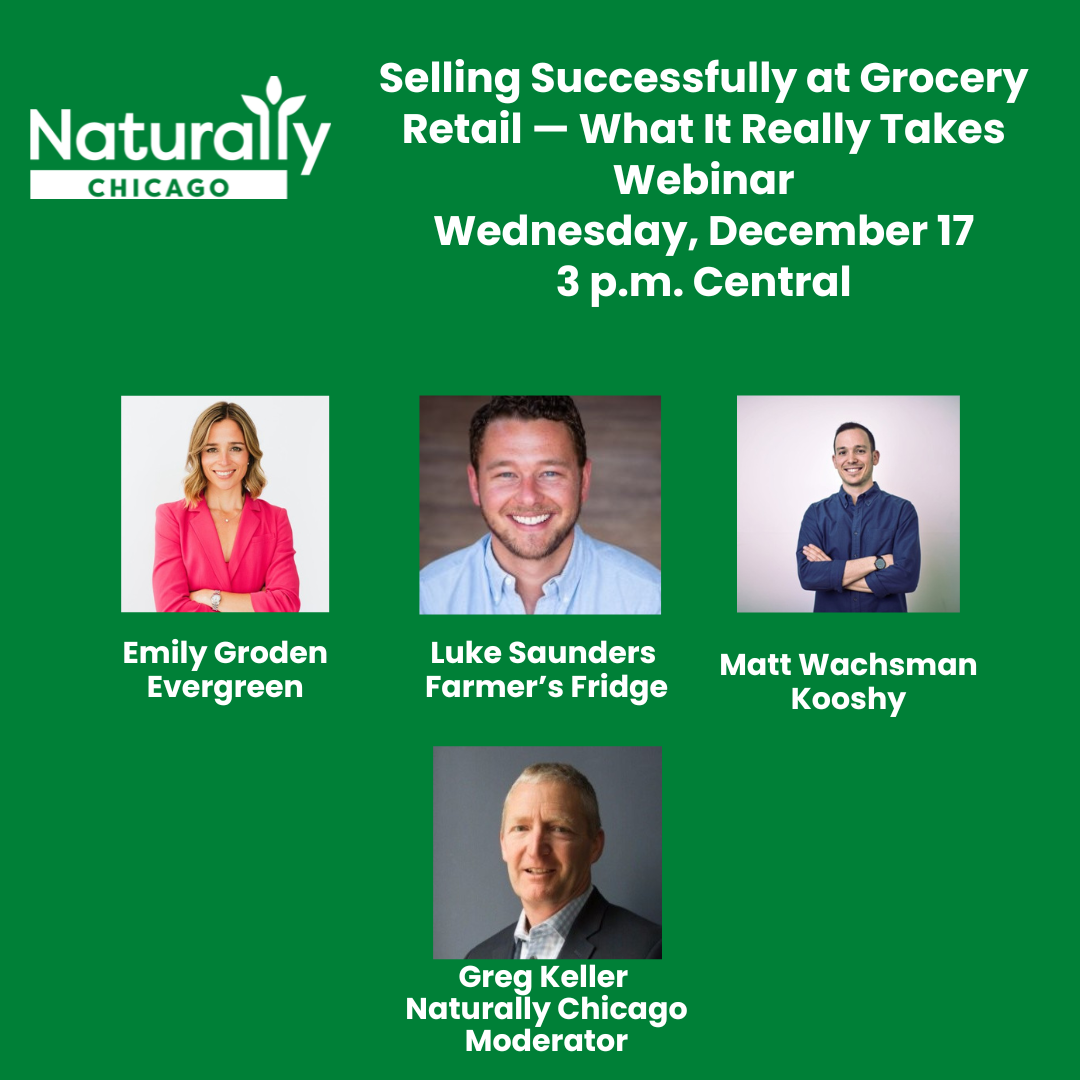
To address and illuminate these issues, Naturally Chicago on December 17 presented a webinar titled “Selling Successfully at Grocery Retail: What It Really Takes.” Moderated by Greg Keller, Naturally Chicago Senior Strategist, the webinar panel features three experienced and successful founders:
Emily Groden, Evergreen Waffles
Luke Saunders Farmer’s Fridge
Matt Wachsman, Kooshy croutons
Emily and Luke serve on Naturally Chicago’s Board of Directors.
All three shared hard-earned insights on four critical retail levers:
Packaging
Retail promotions
In-store demonstrations
Retail media
Together, their perspectives offer a practical playbook for brands looking to stand out on shelf, earn buyer confidence and drive sustainable velocity.
We hope these excerpts and takeaways whet your appetite to click on the link at the bottom and view the full webinar video recording.
Packaging: Your Entire Funnel in One Box
Packaging is often described as a brand’s “silent salesperson,” but in retail, it is more accurately the entire customer funnel compressed into a few square inches.
As Luke Saunders explained, packaging must perform multiple jobs simultaneously:
Stop the shopper
Communicate differentiation
Reinforce quality and trust
Close the purchase
Key Packaging Principles
1. Differentiation is non-negotiable
If your packaging blends in, your product will will fail to stand apart from everything else in the category.
Farmer’s Fridge, which has had great success at selling salads and other fresh foods from strategically located vending machines, rejected standard packaging formats to avoid negative category associations.
Kooshy, whose flavorful varieties have disrupted the often-overlooked crouton category, deliberately avoided category norms (e.g., salad imagery on packages).
Evergreen, whose recipes provide unique and healthy flavor combinations to the frozen waffle category, moved away from muted “better-for-you” visuals to bold, high-contrast colors.
2. Show the product — or prove the quality
Different categories demand different strategies:
For Farmer’s Fridge, clear packaging was essential because shoppers decide based on food freshness.
For Kooshy, high-detail photography and visual cues (oven browning, texture) communicated quality.
For Evergreen, warmth and emotional appeal mattered as much as nutrition.
3. Hierarchy matters more than information density
Early-stage brands often try to say everything at once. That is usually a mistake.
“When you launch, you want to scream all of your points of differentiation—but consumers don’t process it that way.”
— Matt Wachsman, Kooshy
4. Packaging changes are expensive — but sometimes transformative
Evergreen’s rebrand in early 2024 resulted in a 62 percent velocity lift overnight, validating the risk.
“Waffles should feel warm and nostalgic. Our old packaging didn’t do that.”
— Emily Groden, Evergreen
Practical Takeaway
Print packaging at scale, place it on shelf next to competitors, and view it from multiple distances. What looks good on a screen often fails under real retail conditions.
Retail Promos: Show Buyers You Understand Their Business
One of the first questions brands face in retail line reviews is simple but loaded:
“How are you going to support this product?”
The subtext is equally important:
Do you understand this retailer’s playbook?
Can you drive trial without damaging the category?
Will you execute consistently?
Promotion Strategies That Actually Work
1. Promotions are about trial, not just discounting
All panelists emphasized that promotions are often the most efficient way for smaller brands to drive initial trial.
“The sale tag alone is sometimes enough to wave your hand in the aisle.”
— Matt Wachsman
2. Different retailers expect different promo strategies
Some demand buy-one-get-one offers (BOGOs).
Others prefer consistent temporary price reductions (TPRs).
Many expect a minimum number of promotional weeks per year.
Sophistication comes from tailoring plans by retailer.
“If you can walk in and say, ‘I know you like BOGOs,’ that builds confidence immediately.”
— Emily Groden
3. Measure impact — even without scan data
Not all brands have access to big data from companies such as Circana or IRI, especially early on.
Distributor shipments can act as a directional proxy.
Over time, shipment trends reveal baseline lifts and promo effectiveness.
4. Execution is often the hidden failure point
A well-designed promo that fails to execute is worse than no promo at all.
Common pitfalls:
Tags not placed
Inventory not loaded into distribution centers
Promotions not correctly entered by distributors
“You can do everything right — and still fail if the execution breaks.”
— Matt Wachsman
Practical Takeaway
Plan promotions conservatively, execute aggressively and follow up relentlessly. Promotion success is as operational as it is strategic.
In-Store Demos: Trial, Feedback and Eyes on the Ground
Demos are not universally effective — but when aligned with the right channel, product and execution model, they can be transformative.
Evergreen’s Demo-First Strategy
Evergreen conducts ~1,000 demos annually at Whole Foods alone, using trained brand ambassadors rather than third-party demo firms.
Benefits include:
Immediate trial and conversion
Real-time consumer feedback
Merchandising and out-of-stock visibility
Long-term regional lift
“We still see stronger performance in regions where our best brand ambassadors demoed years ago.”
— Emily Groden
When Demos Do — and Don’t — Work
They tend to work best when:
The product has a meaningful taste or texture hurdle
The shopper is open to discovery (e.g., natural channel)
The brand can control ambassador quality
They are less effective when:
The category has low purchase frequency
Sampling is operationally complex
Traffic density is insufficient
“Costco demos worked incredibly well for us because shoppers expect to stop and try.”
— Luke Saunders
Strategic Value Beyond Sales
Panelists emphasized the importance of founder-led demos early on.
“I did 400 demos myself. That’s how we fixed packaging, seasoning and sodium levels.”
— Matt Wachsman
Practical Takeaway
Demos are not just a sales tactic — they are a feedback engine. Used selectively, they can accelerate learning far beyond what data alone provides.
Retail Media: The Fastest-Growing Lever in Grocery
Retail media — paid digital placements within retailer ecosystems — has rapidly become one of the most powerful and measurable growth tools for brands.
What Is Retail Media?
At its simplest:
Sponsored product placements on Instacart, Walmart.com, Target.com, etc.
Brands bid on search terms and category placements.
Performance is directly measurable through Returns on Ad Spend (ROAS).
“It’s one of the few marketing levers where you know exactly what you’re getting.”
— Emily Groden
Why Retail Media Matters
1. It drives incremental, measurable velocity
Online sales count the same as in-store sales — and often carry higher margins.
2. Buyers care deeply about online performance
Retailers increasingly view online shoppers as incremental category growth.
“Some buyers will accept lower in-store velocity if online performance is strong.”
— Luke Saunders
3. Barriers to entry are low
Brands can start with as little as $10/day.
Early campaigns can be self-managed.
Agencies become valuable as scale and complexity increase.
4. Listings are digital packaging
Imagery, titles and seasonal updates matter.
“Your retail media listing is another billboard. Don’t sleep on it.”
— Emily Groden
Practical Takeaway
Retail media is no longer optional. It is one of the most efficient ways for emerging brands to punch above their weight — especially with high-income, convenience-driven shoppers.
Pricing: The Lever That Can Break Everything
While not a formal section of the webinar, pricing emerged as a recurring theme.
Key lessons:
Price elasticity can be extreme.
Small price changes can double velocity.
Premium positioning only works within consumer tolerance.
“If your price is wrong, nothing else matters.”
— Luke Saunders
Pricing decisions must balance:
Competitive context
Consumer willingness to pay
Brand positioning
Unit economics
As Matt Wachsman noted, hard decisions early — ingredient trade-offs, pack sizes, margin resets — are far easier than correcting course once distribution scales.
Final Takeaway: No Formula — Only Disciplined Learning
Across packaging, promotions, demos and retail media, one theme was consistent: There is no universal playbook.
What works depends on:
Category
Channel
Shopper behavior
Operational maturity
“You have to test, learn, and then test again. That never stops.”
— Greg Keller
For emerging brands, success in retail is not about perfection — it is about speed of learning, clarity of focus, and excellence in execution.
And, according to Greg, above all:
“You’ve got to be in stores. Talking to customers. That never changes.”